

You booked LTL freight, the quote said three to five business days, and now it is day six with no delivery appointment. That gap between the estimate and reality is one of the most common frustrations in freight shipping, and it usually has a clear cause: LTL transit times measure only part of the journey, and several steps before and after the truck ride add time that nobody mentioned.
This guide explains how LTL transit time is calculated, what actually happens to your freight between pickup and delivery, the factors that cause delays, and how to build a realistic schedule when the delivery date matters, such as a move-in day, a store opening or an event.
What an LTL transit time actually measures
A carrier’s transit time is an estimate of business days from the day the freight is picked up to the day it is delivered. Three details in that definition catch people out:
- Business days only. Weekends and carrier holidays usually do not count. A shipment picked up on Thursday with a three-day transit time may not deliver until the following Tuesday.
- Pickup day is usually day zero. The clock starts the next business day after pickup.
- Estimates, not guarantees. Standard LTL transit times are targets. Guaranteed service exists, but it is a separate, higher-priced option.
Transit time also does not include the time it takes to schedule pickup or to set a residential delivery appointment. Those steps often add a day or more on each end.
The journey of an LTL shipment
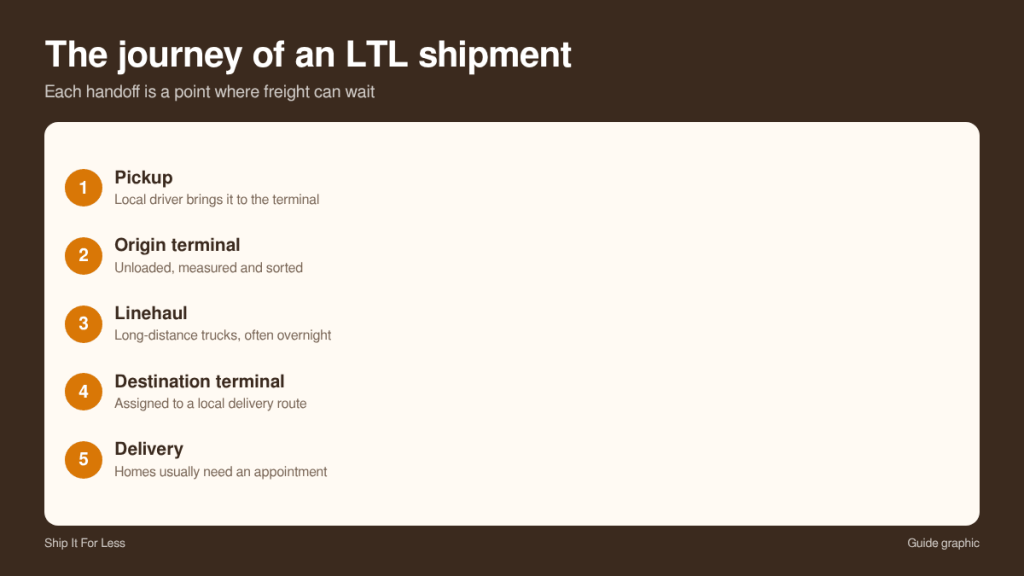
LTL freight moves through a hub-and-spoke network. Knowing the steps makes it easier to see where time is spent.
- Pickup. A local driver collects your freight, often on a route with many other stops, and brings it back to the origin terminal.
- Origin terminal. Freight is unloaded, measured, sometimes reweighed, and sorted by destination.
- Linehaul. Freight travels on long-distance trucks, often overnight, toward a terminal near the destination. Longer trips may pass through one or more break-bulk hubs where loads are re-sorted.
- Destination terminal. Freight is unloaded again and assigned to a local delivery route.
- Delivery. For a business with a dock, delivery may happen the next day. For a residence, the terminal usually calls to schedule an appointment first.
Each handoff between trucks and terminals is a point where a shipment can wait for the next departure. That is why two shipments covering the same miles can have different transit times.
Factors that lengthen transit time
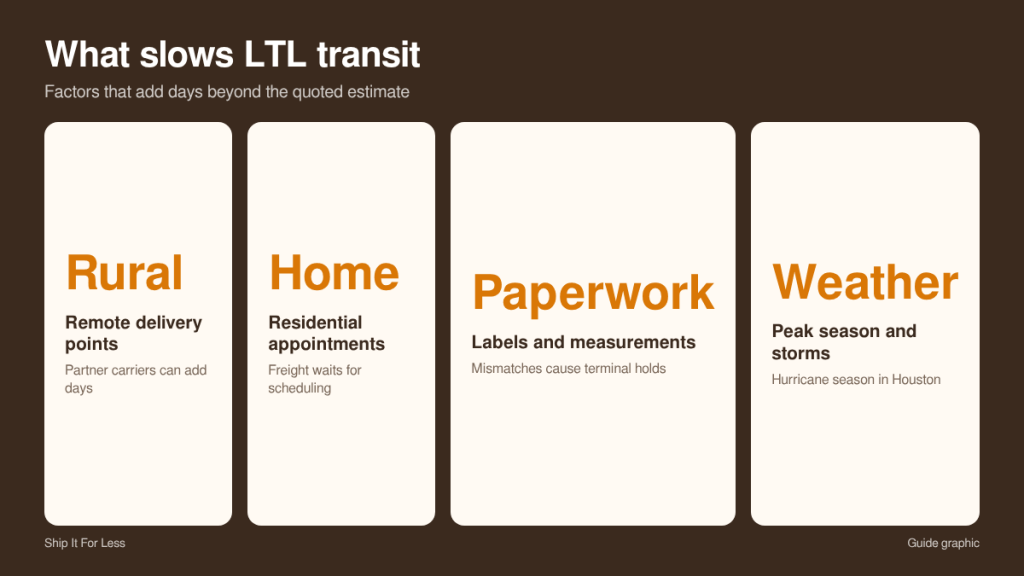
Distance and lane
Distance is the starting point, but the lane matters just as much. Freight moving between two large cities with direct terminal service travels faster than freight going to a small town that the carrier reaches only on certain days.
Rural or remote delivery points
Many carriers serve remote zip codes on a scheduled basis or through a partner carrier. If your destination is outside a carrier’s direct service area, ask whether the freight will be handed to another company and how many days that adds.
Residential delivery and appointments
Residential freight almost always requires a delivery appointment. If the recipient does not answer the scheduling call or picks a date several days out, the freight waits at the terminal. Correct phone numbers on the bill of lading prevent much of this delay.
Accessorial services
Liftgate trucks, inside delivery and limited access locations (schools, churches, construction sites, storage units) may require specific equipment or crews, which can narrow the delivery days available.
Paperwork and measurement problems
Freight that arrives with a missing label, unclear destination or dimensions that do not match the bill of lading can be held while the carrier sorts it out. Clear labels on at least two sides and an accurate bill of lading keep freight moving.
Seasonal volume and weather
Peak seasons, holidays and severe weather all slow freight networks. In the Houston area, hurricane season can disrupt pickups and deliveries for days at a time, so build in extra margin from summer into fall.
How to plan around a delivery date
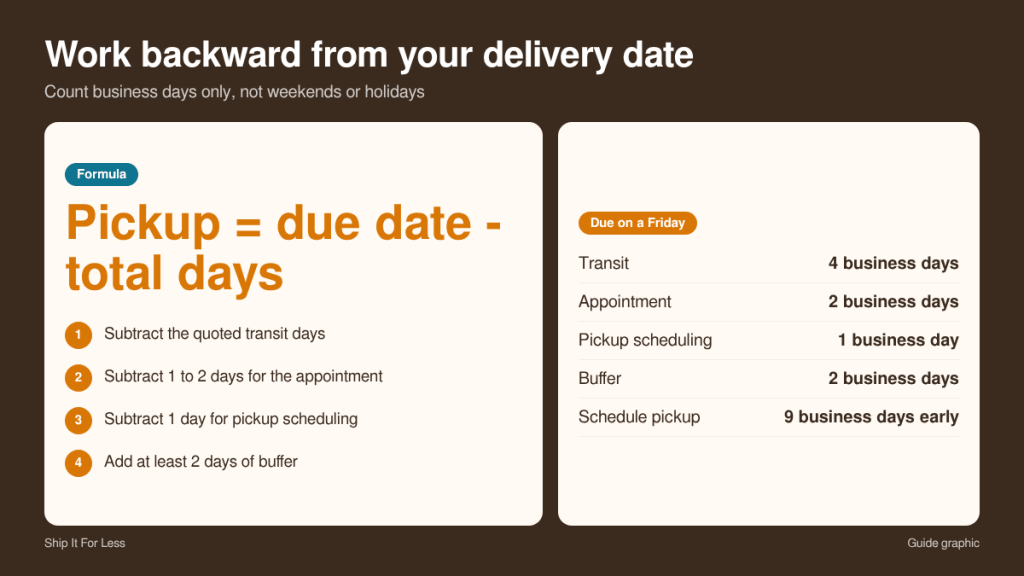
When the date matters, work backward. Here is a simple method using business days.
- Start with the date the freight must arrive.
- Subtract the carrier’s quoted transit time in business days.
- Subtract one or two business days for the delivery appointment, especially for residential delivery.
- Subtract one business day for pickup scheduling.
- Add at least two business days of buffer for weather, holidays or terminal delays.
Worked example
Say your furniture must reach a new home by Friday, and the quoted transit time is four business days. Subtract four business days for transit, two for the residential appointment, one for pickup scheduling and two for buffer. That totals nine business days, so you should schedule pickup nine business days before that Friday. Counting back weekdays only, that lands on Monday of the previous week. If you can ship even earlier and use terminal holding or a storage option, your risk drops further.
Options when speed matters
- Guaranteed LTL service. Many carriers offer a guaranteed delivery date for an extra charge, with a partial or full refund of that charge if they miss it. Read the terms so you know exactly what is promised.
- Expedited or exclusive-use truck. A dedicated truck goes straight from pickup to delivery without terminal stops. It costs more but removes the handoffs that cause delays.
- Air cargo. For time-critical freight, air can cut days off a long-distance shipment, though it brings its own size limits and costs.
- Ship earlier and hold. Sometimes the cheapest way to hit a date is to ship standard LTL early and have the freight wait at a terminal or storage facility.
How to track and follow up
Once freight is moving, a few habits help you catch problems early:
- Save the PRO number, which is the carrier’s tracking number, as soon as pickup happens.
- Check tracking daily for terminal arrival and departure scans.
- If the status has not changed in two business days, call the carrier or your booking agent and ask where the freight is physically located.
- When the freight reaches the destination terminal, call to confirm the delivery appointment rather than waiting for the carrier to call.
- Ask the recipient to keep their phone on and to answer unknown numbers during the delivery window.
What to do if your freight is running late
Even with good planning, freight sometimes misses its estimate. A calm, organized follow-up gets answers faster than repeated calls.
- Confirm the facts. Note the pickup date, the quoted transit time and the last tracking scan, including the terminal location.
- Ask specific questions. Instead of “where is my freight,” ask whether it has left the origin terminal, which terminal it is at now, and when the next scheduled departure or delivery route is.
- Check for holds. Ask whether the shipment is held for an appointment, a missing phone number, a measurement review or an address problem. Many delays are paperwork issues you can fix in one call.
- Offer alternatives. If the destination is a home and timing is tight, ask whether you can pick the freight up at the destination terminal yourself. That can save a day or more.
- Keep a record. Write down who you spoke with, the date and what they said. If you bought guaranteed service, you will need this to request the refund the terms allow.
If you booked through a broker or shipping agent, let them make these calls. They usually have direct contacts at the carrier and can escalate faster than an individual shipper.
Frequently asked questions
How long does LTL freight take?
Short regional moves can take one to three business days, while cross-country shipments often take a week or more. Your quote shows the carrier’s estimate for your specific lane.
Do LTL carriers deliver on weekends?
Standard LTL service usually runs Monday through Friday. Weekend delivery, if available, is a special service that costs extra.
Why is my freight sitting at the terminal?
Common reasons include waiting for a delivery appointment, waiting for the next linehaul departure, or a paperwork or measurement issue. Call the carrier with your PRO number to find out.
Can I get a guaranteed delivery date?
Yes, many carriers offer guaranteed service on certain lanes for an added charge. Confirm the guarantee terms in writing before you book.
Shipping on a deadline?
Compare transit times across carriers before you commit. The Postal Spot’s Houston freight shipping service can quote multiple LTL and air options for your dates.