

Appliances are some of the hardest household items to ship. They are heavy, awkwardly shaped and full of parts that do not like being bounced around: compressors, glass doors, drums, gas fittings and control panels. Many are also too large or too heavy for parcel carriers, which means freight is usually the only practical option once you are moving one across town or across the country.
This guide covers the steps that apply to every appliance, then walks through the specific prep for refrigerators, freezers, washers, dryers, dishwashers, ranges, microwaves and smaller countertop units. It finishes with how to pack appliances for LTL freight and what to check on delivery day.
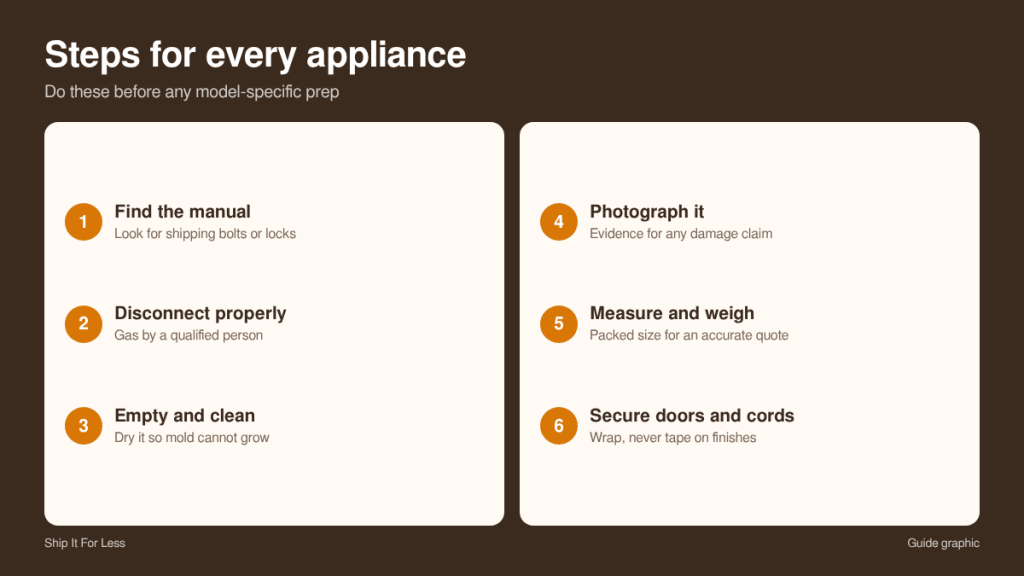
Steps that apply to every appliance
No matter what you are shipping, start with these basics:
- Find the manual or model number. Manufacturers often publish moving or transport instructions, including shipping bolts, locking screws or upright requirements. Search the model number if the manual is gone.
- Disconnect power, water and gas properly. Gas lines should be shut off and disconnected by a qualified person. Water supply valves should be closed and lines drained.
- Empty and clean it. Remove food, detergent, filters, racks and loose items. Clean and dry the interior so mold and odors do not develop in transit.
- Photograph it. Take photos of every side, the control panel and any existing marks. These are your evidence if you need to file a damage claim.
- Measure and weigh it. Measure the packed size in inches and note the weight from the spec sheet plus packaging. You need these numbers for an accurate freight quote.
- Secure doors and cords. Tape cords to the back, and secure doors with stretch wrap or straps rather than tape directly on finished surfaces, which can leave residue.
Refrigerators and freezers
Refrigerators are the appliance most people worry about, mainly because of the compressor and the refrigerant system.
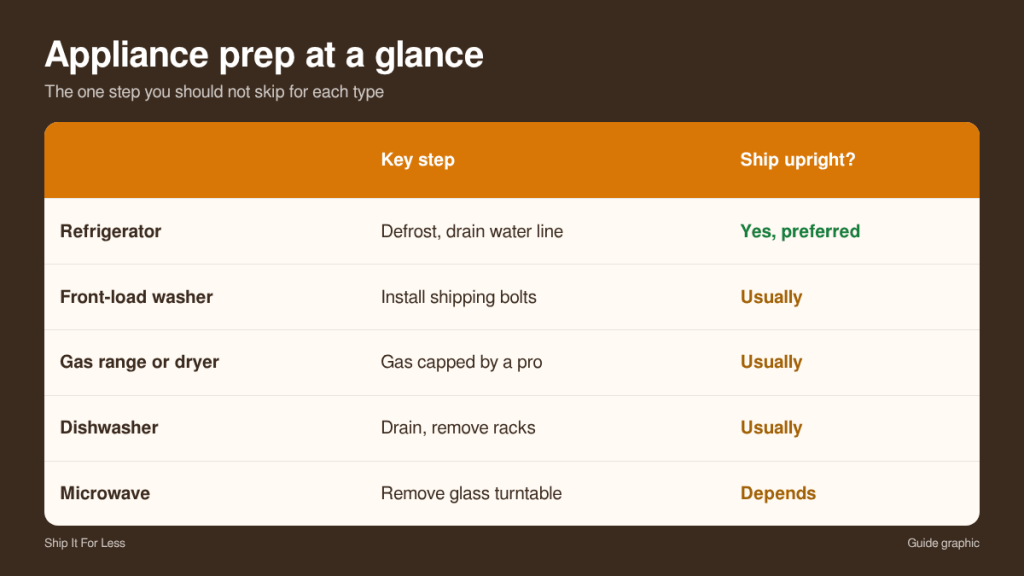
- Unplug it at least a day before pickup so the freezer can defrost. Empty the drip pan and dry everything.
- Disconnect and drain the water line if it has an ice maker or dispenser.
- Remove or tape down shelves and drawers, or pack them separately.
- Ship it upright whenever possible. Many manufacturers advise against laying a refrigerator on its side, and some say that if it has been transported lying down, it should stand upright for a period before you plug it in. Follow the manufacturer’s guidance for your model.
- Prop the doors slightly open at the destination until it is plugged in, so odors do not build up.
Chest freezers and wine fridges follow similar rules: defrost, dry, keep upright and follow the manufacturer’s waiting period before plugging in.
Washers and dryers
Front-load washers
Front-load washers usually have shipping bolts that lock the drum. If you still have the bolts, reinstall them before shipping. If not, many manufacturers sell replacement transit bolts by model. A loose drum can bounce on its suspension and damage the shocks or bearings.
Top-load washers
Top-load models may not use shipping bolts, but the tub still needs support. Check the manual. Some recommend packing the space between tub and cabinet with towels or foam to limit movement.
Hoses and water
Disconnect the fill and drain hoses, drain as much water as possible, and let the washer air dry with the door open. Bag the hoses and tape the bag inside the drum.
Dryers
Electric dryers mainly need the cord secured and the lint trap cleaned. Gas dryers need the gas line shut off and capped by a qualified person. Remove the vent hose and pack it separately.
Dishwashers, ranges and cooktops
Dishwashers
- Shut off water and power, then disconnect the supply line and drain hose.
- Place a shallow pan or towels underneath to catch residual water.
- Remove racks and utensil baskets, or secure them with ties so they do not roll.
- Protect the front panel and the bottom edges, which are easy to dent once the unit is out of the cabinet.
Ranges, ovens and cooktops
- For gas ranges, have the gas shut off and the connection capped by a qualified person.
- Remove grates, burner caps, knobs and oven racks. Wrap and box them separately so they do not damage the cooktop surface.
- Glass and ceramic cooktops are fragile. Cover the top with a sheet of cardboard or foam before wrapping.
- Tape the oven door closed with stretch wrap around the body, not tape directly on the finish.
Microwaves and countertop appliances
Smaller appliances such as microwaves, toaster ovens, mixers and espresso machines can often go by parcel if they are well boxed and inside carrier limits. FedEx and UPS accept packages up to 150 pounds and 165 inches in length plus girth, while USPS accepts up to 70 pounds and 130 inches in length plus girth.
- Remove glass turntables, trays and attachments and wrap them separately.
- Use a box with at least 2 inches of cushioning on every side.
- For espresso machines, empty the water tank and run the machine dry if the manufacturer recommends it.
Packing appliances for LTL freight
Large appliances should usually ship on a pallet or in a crate:
- Wrap the appliance in moving blankets or furniture pads to protect the finish.
- Add stretch wrap over the pads to hold them in place.
- Place the appliance upright on a sturdy pallet sized so nothing hangs over the edges.
- Strap it to the pallet with ratchet straps or banding. Add corner boards under the straps to prevent dents.
- Mark “This Side Up” and “Do Not Stack” on all sides.
- Attach a label with the destination and contact phone number on at least two sides.
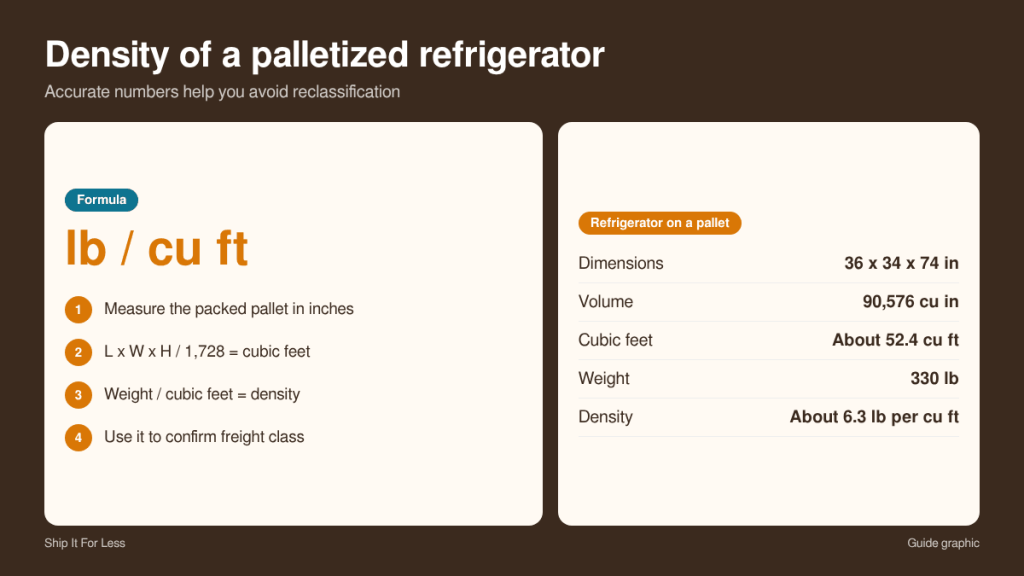
Example density check
A refrigerator on a pallet measuring 36 x 34 x 74 inches is 90,576 cubic inches. Divided by 1,728, that is about 52.4 cubic feet. At 330 pounds packed, its density is about 6.3 pounds per cubic foot. Under the density-based NMFC system in place since July 19, 2025, accurate numbers like these help you get the correct freight class and avoid reclassification charges.
Parcel or freight: a quick way to decide
Use this rule of thumb to decide how each appliance should travel:
- Parcel: microwaves, toaster ovens, small wine coolers, stand mixers, coffee machines and air fryers, as long as the boxed weight and size stay within carrier limits.
- Freight: refrigerators, freezers, washers, dryers, dishwashers, ranges and wall ovens. These almost always exceed parcel limits or are too heavy to handle safely as a box.
- Freight with crating: high-end ranges, commercial-style refrigerators, appliances with large glass doors, or anything with a finish you cannot afford to scratch.
If you are moving several appliances to the same address, ship them together as one LTL shipment. Two appliances strapped to separate pallets on one bill of lading are usually simpler to track and deliver than two separate bookings, and one delivery appointment covers both.
Before you book: appliance checklist
- Manual or model number located and moving instructions checked
- Power, water and gas disconnected by the right person
- Interior emptied, cleaned and dry
- Shipping bolts installed for front-load washers
- Loose parts removed, wrapped and boxed
- Packed dimensions and weight recorded
- Liftgate and residential delivery requested if needed
Delivery day
- Arrange a liftgate if the delivery address has no loading dock. Appliances are too heavy to lift off a truck by hand safely.
- Request inside delivery if you need the appliance brought past the curb or garage.
- Inspect the pallet and wrapping before signing. Note any damage on the delivery receipt, even if it looks minor.
- Unpack promptly and check for hidden damage. Report concealed damage to the carrier quickly with photos.
- Wait the recommended time before plugging in refrigerators and freezers, and have gas appliances reconnected by a qualified person.
Frequently asked questions
Can I ship a refrigerator on its side?
It is best to ship upright. Some manufacturers allow side transport with a waiting period before you plug it in. Check the guidance for your model.
Do I need shipping bolts for a front-load washer?
Yes, they are strongly recommended. They lock the drum and protect the suspension. Replacement bolts are often available by model number.
Can appliances ship by UPS or FedEx?
Small countertop appliances can, if boxed within parcel limits. Full-size appliances usually exceed those limits and need freight.
Do I need a liftgate for appliance delivery?
Usually yes for residential delivery, since homes rarely have a loading dock. Add it when you book so it is included in the quote.
Moving appliances out of Houston?
The Postal Spot ships large appliances by freight, with palletizing, crating and liftgate delivery options from its Houston store.