

Towing a travel trailer or camper across the country yourself takes time, fuel, a capable tow vehicle and a lot of nerve on mountain grades and crowded highways. If you bought a trailer out of state, are relocating, or simply do not have a truck rated to pull it, shipping it with a professional hauler can be the more practical choice. The process is different from shipping a car, though, and it rewards careful preparation.
This guide covers the main ways travel trailers, campers, pop-ups and small RVs are transported, how to choose between them, the step-by-step prep that protects your rig and its systems, what documents you need, and how to inspect it on arrival.
The main ways to ship a trailer or RV
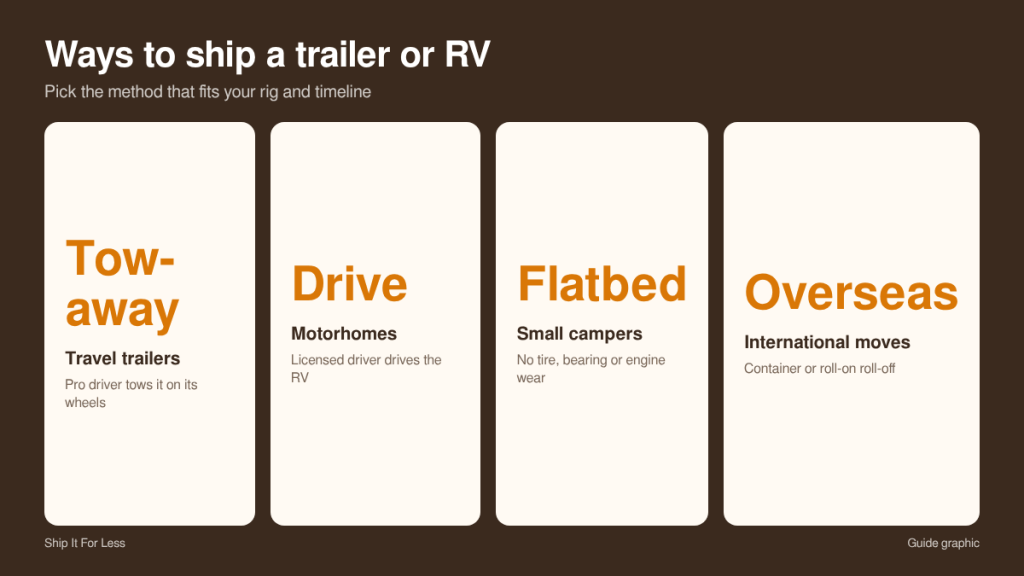
Tow-away service
For towable trailers (travel trailers, fifth wheels, toy haulers and pop-ups), the most common method is a tow-away service. A professional driver with a properly rated truck hitches your trailer and tows it to the destination. Your trailer rolls on its own tires and axles the whole way.
Drive-away service
For motorized RVs (Class A, B and C motorhomes), a drive-away service sends a licensed driver to drive the RV to its destination. The RV accumulates miles and uses its own fuel.
Flatbed or step deck transport
Smaller campers, pop-ups, teardrop trailers, truck campers and some Class B vans can ride on a flatbed or step deck trailer. The rig does not roll on its own wheels, so there is no wear on tires, bearings or the engine. This option is also useful when the trailer has mechanical issues that make towing unsafe.
Container or enclosed transport
Very small trailers and teardrops sometimes fit inside an enclosed trailer or container, which is common for overseas moves. Larger rigs usually travel by roll-on/roll-off ship for international moves.
How to choose a method
- Is it towable or motorized? Towables usually go by tow-away. Motorhomes usually go by drive-away or flatbed.
- How large is it? Long or tall rigs need tow-away or drive-away. Small rigs have more options.
- Is it roadworthy? Worn tires, bad bearings, faulty brakes or broken lights may rule out towing until they are repaired. A flatbed avoids those risks.
- How much wear do you accept? Tow-away adds tire and bearing wear. Drive-away adds miles. Flatbed adds neither.
- How tight is the timeline? Tow-away and drive-away drivers often go point to point, which can be faster than a multi-stop flatbed.
Mechanical preparation for towing
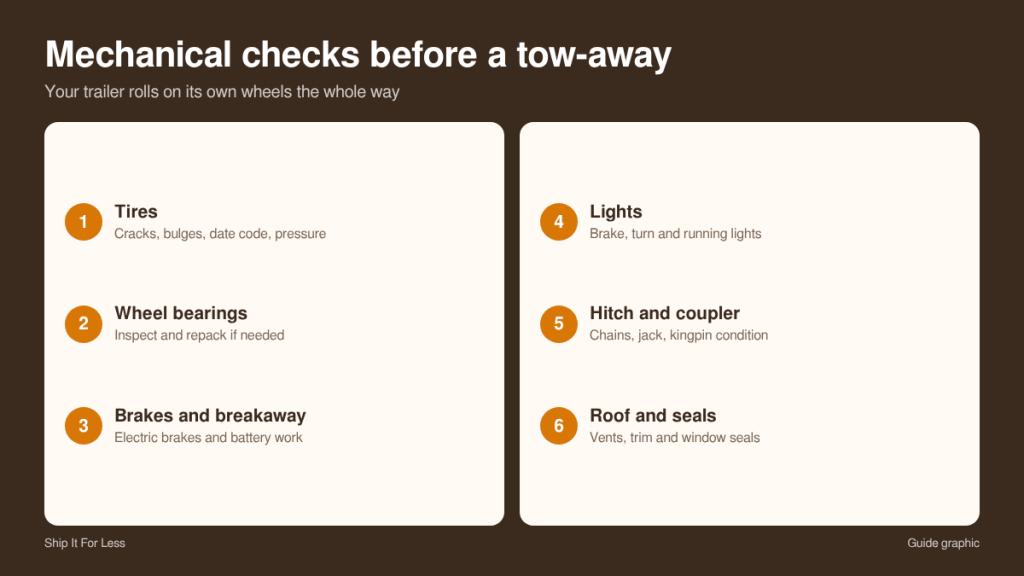
If your trailer will roll on its own wheels, it must be safe for the highway. Before pickup, check or have a technician check:
- Tires. Look for cracks, bulges and tread depth, and check the date code. Inflate to the pressure on the trailer’s placard, and include the spare.
- Wheel bearings. Bearings that have not been serviced in a long time are a common cause of roadside breakdowns. Have them inspected and repacked if needed.
- Brakes and breakaway switch. Electric brakes and the breakaway battery should work correctly.
- Lights. Brake lights, turn signals and running lights must function.
- Hitch and coupler. Check the coupler or kingpin, safety chains and jack for damage or wear.
- Roof and seals. Inspect the roof, vents and window seals. Highway wind can lift loose trim and drive rain into gaps.
Keep receipts or notes from any service you have done. If a tire or bearing fails during transport, a record showing recent inspection helps you and the transporter work out what happened. It also gives the driver confidence that the trailer is ready for long highway miles, and some transporters will ask about recent maintenance before they accept a tow-away job.
Preparing the interior and systems
Water and waste
- Drain fresh water, gray water and black water tanks. Full tanks add a lot of weight and can slosh.
- Drain the water heater and open low-point drains if the trailer will travel through freezing weather.
Propane
Close the propane tank valves and turn off all propane appliances. Ask your transporter about its policy on propane cylinders, since rules vary and some transporters require tanks to be closed and secured or removed.
Electrical
- Turn off the main breaker and disconnect or switch off house batteries unless the transporter needs power for the breakaway system.
- Remove or secure solar panels, antennas and satellite dishes that could catch wind.
Inside the rig
- Remove valuables, documents, electronics and anything breakable.
- Secure cabinet doors, drawers, the refrigerator door and the shower door with tape or latches.
- Lay down or wrap TVs and mirrors, or remove them.
- Lower and lock the TV antenna, retract and lock slide-outs, stabilizer jacks and awnings.
- Close and lock all windows, roof vents and exterior compartments.
Documents and condition report
Before pickup, assemble:
- Current registration and proof of ownership. Transporters usually need to see them, and some states require registration to be valid for the trailer to travel on public roads.
- Proof of insurance. Ask whether your RV policy covers the trailer while it is being transported by a third party, and what the transporter’s cargo coverage includes.
- A set of keys for doors and compartments, labeled.
- Photos of every exterior side, the roof, the interior, the tires and the hitch, with date stamps.
At pickup, the driver should complete a written condition report. Walk around the rig together and make sure every existing scratch, dent or crack is noted. Keep your copy.
Example: planning a cross-country tow-away
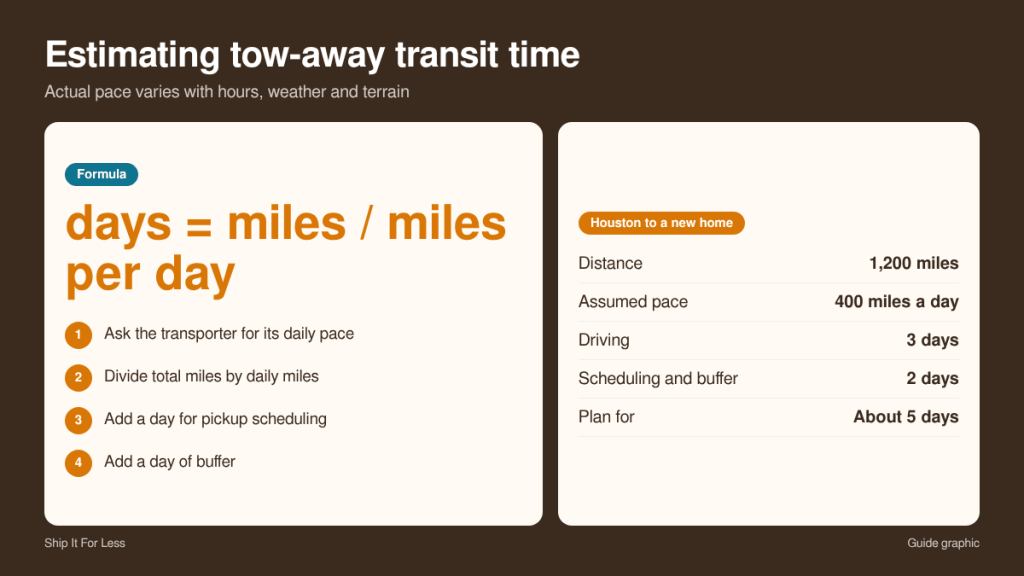
Suppose you are moving a travel trailer from Houston to a new home 1,200 miles away. Tow-away drivers often cover a few hundred miles a day depending on hours, weather and terrain. If you assume 400 miles a day, the drive alone takes 1,200 divided by 400, or 3 days. Add a day for pickup scheduling and a day of buffer, and plan on about 5 days from pickup to arrival. Ask the transporter for its own estimate, since actual pace varies.
Questions to ask before you book
Not every transporter handles every rig, and the answers to a few questions tell you a lot about the service you will get:
- What method will you use for my trailer? Tow-away, drive-away or flatbed, and why.
- Is the driver experienced with my type of rig? Fifth wheels, toy haulers and long travel trailers handle differently from small campers.
- What does your cargo insurance cover? Ask about the coverage amount, the deductible and exclusions such as tires, interior contents or pre-existing damage.
- Who pays for a breakdown on the road? If a tire blows or a bearing fails during tow-away, find out whether you are billed for repairs.
- How will you update me? Ask how often you will hear from the driver and whether they share location updates.
- What happens if no one is at delivery? Know the policy before you schedule the delivery date.
Get the answers in writing along with the quote. If something goes wrong in transit, that written record makes it much easier to resolve.
Delivery and inspection
- Be present at delivery, or send someone you trust with the condition report.
- Walk around the rig with the driver and compare it to your photos and the pickup report.
- Check the roof, slide-outs, awning, lights and tires before signing.
- Note any new damage on the delivery report, then photograph it.
- Inside, open cabinets and check for shifted items, leaks or broken fixtures.
- Test the systems (water, propane, electrical, slide-outs) soon after delivery, and report problems to the transporter right away.
Frequently asked questions
What is a tow-away service?
A professional driver hitches your travel trailer or fifth wheel to their own rated truck and tows it to the destination on its own wheels.
Can I leave belongings inside my camper during transport?
Ask the transporter. Many limit or prohibit personal items, and cargo insurance may not cover them. Remove valuables either way.
Can a pop-up camper ship on a flatbed?
Often yes. Pop-ups and small trailers fit well on flatbeds or step decks, which avoids tire and bearing wear.
Do I need to empty the tanks before shipping?
Yes. Drain fresh, gray and black tanks to reduce weight and prevent leaks or sloshing.
Need a camper or trailer moved?
Compare transport options before you commit. Freight and vehicle shipping from Houston can cover trailers, campers and other large items.