

The garage is usually the last room people pack and the one that causes the most trouble. It is full of heavy tools, awkward shapes, sharp edges, half-empty cans of chemicals, yard equipment with fuel in it, and years of things nobody has sorted. Sheds and workshops add stationary power tools, lumber offcuts, cabinets full of hardware and machines that weigh hundreds of pounds. Packing it all in the final days before a move almost guarantees damage, delays or a load the carrier refuses to take.
This guide gives you a step-by-step plan for sorting, packing and shipping the contents of a garage, shed or workshop. It covers what you should not ship, how to pack hand tools, power tools and stationary machines, how to prepare lawn and outdoor equipment, and how to organize everything for freight so it arrives together and unloads easily.
Start early and sort first
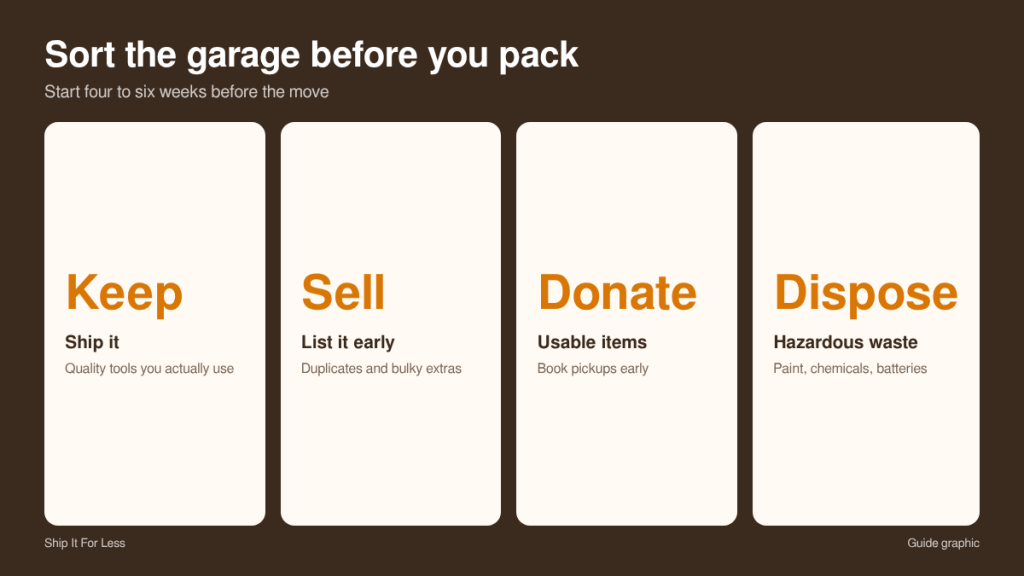
Begin at least four to six weeks before your move. Garages take longer than any other room because of the sorting involved.
- Sort into four piles: keep and ship, sell, donate, and dispose.
- Be honest about duplicates. Many garages have three tape measures, two sets of sockets and a drawer of mystery cords. Shipping heavy duplicates costs more than replacing them.
- Weigh the value of bulky items. Old lumber, cheap shelving and worn yard tools are often not worth shipping. Compare their replacement cost with the space and weight they would take.
- Schedule hazardous waste disposal. Many cities hold household hazardous waste collection days or have drop-off sites for paint, chemicals and batteries. Check your local schedule early.
What you should not ship
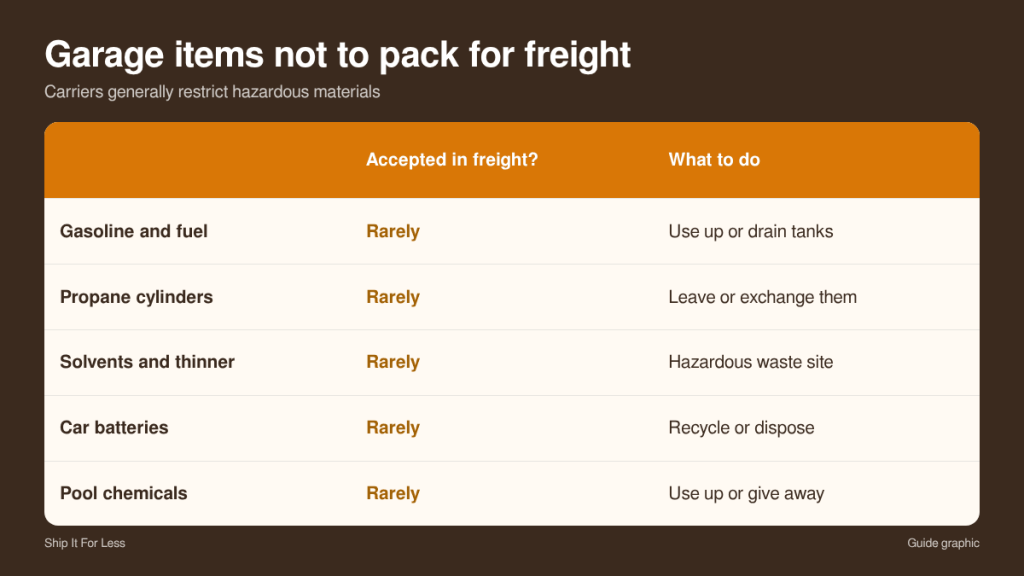
Carriers generally restrict or refuse hazardous materials in household goods shipments. Plan to use up, give away or properly dispose of:
- Gasoline, diesel, kerosene and other fuels, including fuel left in equipment tanks
- Propane cylinders and other compressed gas tanks
- Paint thinner, solvents, lighter fluid and other flammable liquids
- Pool chemicals, pesticides, fertilizers and strong cleaners
- Aerosol cans in quantity
- Car batteries and other wet-cell batteries
- Ammunition, fireworks and similar items
Rules differ by carrier and by material, so if you are unsure about an item, ask before you pack it. Hiding a restricted item in a box can lead to refused freight, fines or a dangerous incident.
Do a final sweep of shelves, cabinets and the corners of the garage floor before you seal the last box. Small cans of spray paint, starter fluid and fuel stabilizer are easy to miss and easy to toss into a box of tools without thinking.
Packing hand tools and hardware
- Toolboxes: keep tools in their boxes, but remove the heaviest items if the box becomes too heavy to lift. Tape or zip-tie drawers closed through stretch wrap so they cannot slide open.
- Loose hand tools: bundle similar tools with tape or rubber bands, wrap sharp edges in cardboard or towels, and pack them in small, strong boxes. Small boxes keep weight manageable.
- Hardware: pour screws, nails, bolts and fasteners into labeled zip bags or plastic containers with lids, then box them. Do not leave loose fasteners in open bins.
- Saw blades and bits: cover teeth with blade guards or cardboard sleeves. Keep drill bits and router bits in their cases.
- Long tools: bundle rakes, shovels, brooms and similar tools with tape or stretch wrap, with heads wrapped and pointing the same direction.
Packing power tools
Portable power tools
- Remove blades, bits and batteries. Store batteries in a separate box with terminals taped or capped, and follow your carrier’s rules for lithium-ion batteries.
- Use original cases when you have them. Otherwise, wrap each tool in padding and box it with cushioning.
- Coil and tape cords so they do not snag.
Stationary tools
Table saws, band saws, drill presses, jointers and planers are heavy, top-heavy and precise. Treat them like small machinery.
- Lower blades and cutters fully, and remove them where practical. Remove fences, guards and extension wings and pack them separately.
- Lock any moving tables or carriages.
- Secure cords and remove loose accessories.
- Bolt or strap each machine to a pallet. Use blocking around the base so it cannot slide.
- Coat exposed cast iron surfaces lightly with a rust preventive if the shipment will spend time in heat and humidity, and cover them.
Lawn, garden and outdoor equipment
- Push mowers, trimmers and blowers: run the fuel tank dry or drain it according to the manual. Drain oil if the manual recommends it for transport.
- Riding mowers and large equipment: follow the manufacturer’s transport guidance, drain fuel as required, and secure or disconnect the battery.
- Hoses: drain and coil them, then bag or box them.
- Grills and smokers: remove propane cylinders, clean grease and ash, and remove grates.
- Bikes: lower or remove handlebars and pedals, and box them or strap them to a pallet with padding.
Organizing garage contents for freight
Freight works best when the garage is packed into uniform, stackable boxes and consolidated onto pallets.
- Use small and medium boxes for tools and hardware. Heavy items in large boxes are hard to handle and prone to bursting.
- Label each box with its contents and the room it belongs in at the new home, such as “Garage, wall shelf, hand tools.”
- Stack heavy boxes on the bottom of the pallet and lighter boxes on top, keeping everything inside the pallet edges.
- Stretch wrap each pallet completely and strap it.
- Put stationary tools on their own pallets or crates.
- Number each pallet (“1 of 4,” “2 of 4”) so you can confirm they all arrive.
Shelving, cabinets and workbenches
Metal shelving units usually come apart into flat uprights and shelves that bundle neatly with stretch wrap. Rolling tool chests should be emptied of their heaviest contents, drawers secured, and casters locked or removed so the chest cannot roll on the pallet. Wall cabinets and workbenches should be emptied and, where possible, disassembled. Bag and label all hardware and tape the bag to the largest piece.
Pack a first-week box
Your freight may arrive a few days after you do. Set aside one box that travels with you in the car: a basic tool kit, a cordless drill and charger, a tape measure, a utility knife, a flashlight, an extension cord, a few common fasteners and some trash bags. You will need these to assemble furniture and fix small problems before the rest of the garage shows up.
Worked example: estimating weight
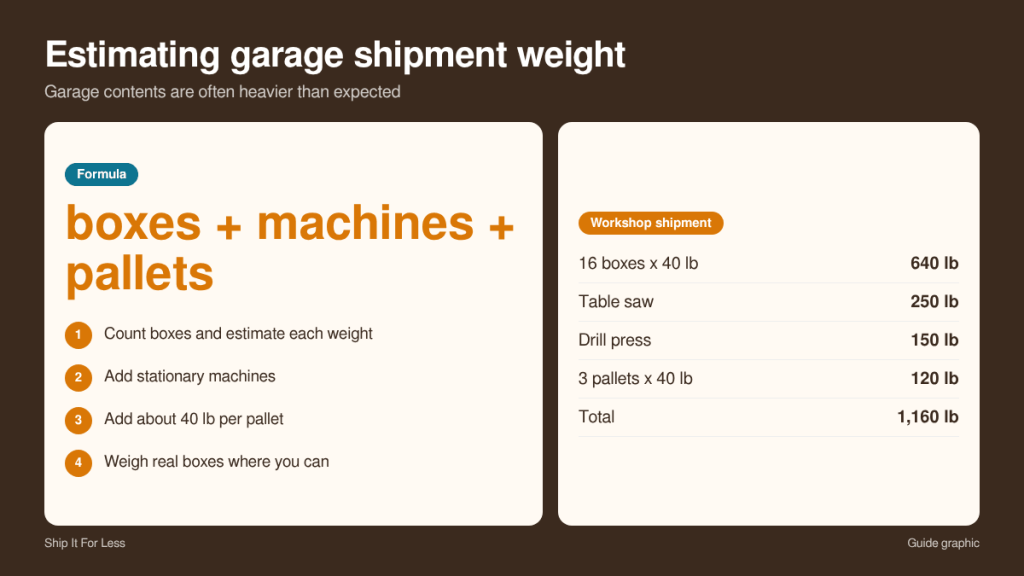
Suppose you pack 16 boxes of hand tools and hardware at about 40 pounds each, plus a table saw at 250 pounds and a drill press at 150 pounds. The boxes total 16 x 40 = 640 pounds. Add the machines for 640 + 250 + 150 = 1,040 pounds. With about 40 pounds of pallet weight for each of 3 pallets (120 pounds), your shipment is roughly 1,160 pounds. Weigh actual boxes where you can, since garage contents are often heavier than expected and accurate weights prevent reweigh charges on your freight invoice.
Moving day and unpacking
- Request a liftgate for pickup and delivery if there is no dock.
- Check that every pallet is labeled and numbered before it leaves.
- At delivery, count pallets and inspect wrap and straps before signing. Note any damage on the delivery receipt.
- Unpack stationary tools first and set them up on level ground, checking alignment before use.
- Report concealed damage to the carrier promptly with photos.
Frequently asked questions
Can I ship a lawn mower with gas in it?
No. Drain fuel or run the tank dry first. Carriers generally do not accept fuel in household goods shipments.
How should I pack power tool batteries?
Remove them from tools, tape or cap the terminals, pack them separately and check your carrier’s rules for lithium-ion batteries.
What do I do with old paint and chemicals?
Use them up, give them away, or take them to a household hazardous waste collection site.
Should I ship a table saw or sell it?
If it is high quality and set up well, shipping it on a pallet is often worthwhile. Compare replacement cost with shipping cost before deciding.
Need to move a full workshop?
Palletized freight shipping in Houston can move tools, machines and garage contents together, with liftgate delivery at your new home.