

Every long-distance move forces the same question room by room: is this piece worth shipping, or would it be smarter to sell it and buy something at the new place? Get it wrong in one direction and you pay to move a worn-out sofa across the country. Get it wrong in the other and you sell a solid wood dresser for a fraction of its value, then pay more for a weaker replacement. Most people decide on gut feeling, often in a rush during the last week, which is when the worst decisions happen.
This guide gives you a clear method for deciding what to ship, sell, donate or replace. It covers the factors that matter (replacement cost, condition, sentimental value, fit in the new home and shipping cost), a simple scoring approach you can apply to each piece, worked examples, and tips for selling or donating what you leave behind.
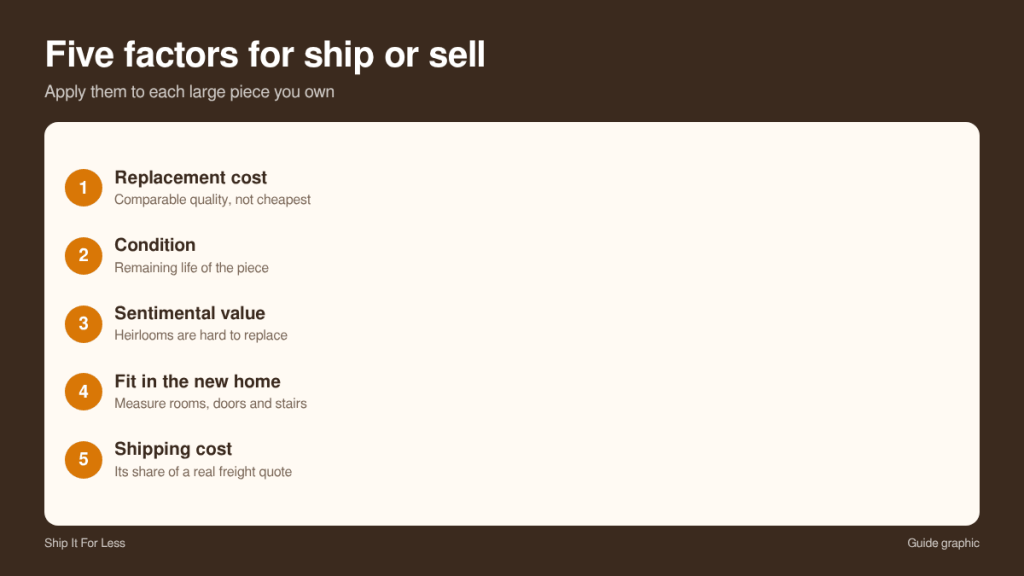
The five factors that decide it
1. Replacement cost
Ask what it would cost to buy an equivalent piece of similar quality at your destination, not the cheapest substitute. Solid hardwood furniture, quality mattresses, well-made sofas and good appliances can be expensive to replace. Flat-pack furniture, inexpensive bookshelves and basic tables are usually cheap to replace.
2. Condition and remaining life
A piece near the end of its useful life is rarely worth shipping. Sagging cushions, wobbly joints, stained upholstery, cracked particleboard and aging appliances should usually stay behind. Flat-pack furniture also tends to weaken each time it is taken apart and reassembled.
3. Sentimental and heirloom value
Some pieces cannot be replaced at any price: a grandparent’s rocking chair, a family dining table, an antique cabinet. These are almost always worth shipping, ideally with professional packing or crating.
4. Fit in the new home
Measure the new rooms, doorways, stairways and elevators before you decide. A large sectional that fits a suburban living room may not fit a city apartment, and a king bed may crowd a smaller bedroom. If you do not have floor plans, ask for room dimensions from the landlord, builder or listing agent.
5. Shipping cost
Freight cost depends on weight, packed size, density, distance and delivery services. Bulky, light pieces like upholstered chairs take up a lot of space relative to their weight. Dense pieces like solid wood dressers weigh more but pack efficiently. Request quotes for your actual items to compare against replacement cost.
A simple decision method
For each larger piece, compare two numbers:
- Cost to keep: the share of shipping cost for this item plus any packing or crating.
- Cost to replace: the price of a comparable item at the destination, minus what you can sell the current item for.
If the cost to keep is clearly lower, ship it. If the cost to replace is clearly lower, sell or donate it. If the two are close, let condition, fit and sentimental value decide.
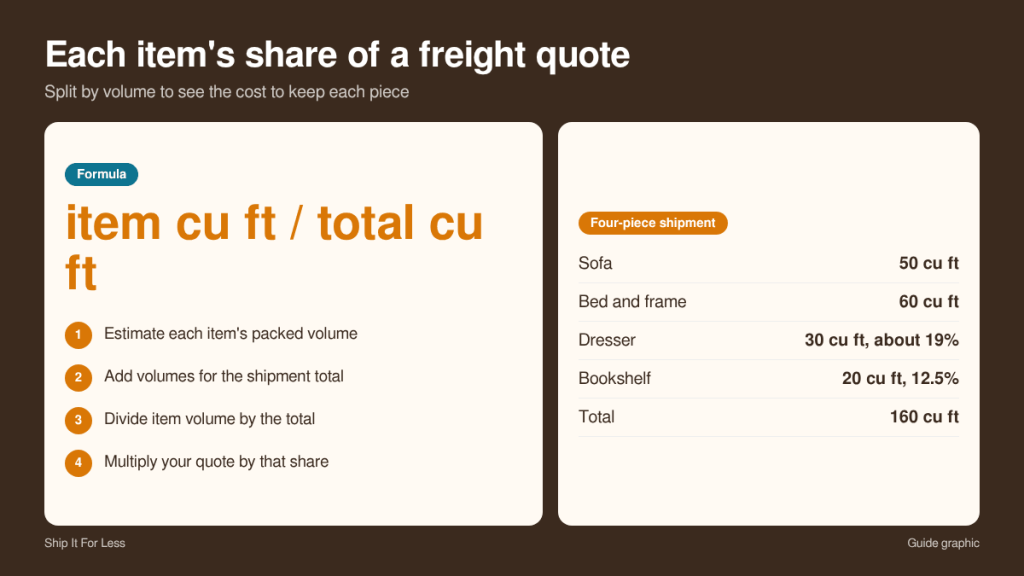
Worked example: splitting a freight quote by item
A freight quote usually covers the whole shipment, so you need a fair way to work out each item’s share. Splitting by volume is a simple approach that works well for furniture.
- Estimate the packed volume of each item in cubic feet (length x width x height in inches, divided by 1,728).
- Add the volumes to get the shipment total.
- Divide each item’s volume by the total to get its share.
- Multiply your quote by that share to get each item’s cost to keep.
Say you are considering four pieces: a sofa at 50 cubic feet, a bed and frame at 60, a dresser at 30 and a bookshelf at 20. The total is 50 + 60 + 30 + 20 = 160 cubic feet. The dresser’s share is 30 divided by 160, or about 19 percent of the quote. The bookshelf’s share is 20 divided by 160, or 12.5 percent. Apply those percentages to your actual quote.
Applying the shares
Now compare each share with the net cost to replace. For the solid wood dresser, look up what a comparable dresser costs near your new home and subtract what yours would sell for locally. Quality hardwood case pieces usually cost much more to replace than their share of a freight shipment, so the dresser is a strong candidate to ship.
For a flat-pack bookshelf, the picture often flips. It may be inexpensive to replace, it sells for little, and it weakens each time it is taken apart. Even a modest 12.5 percent share of the quote can be close to or above its replacement cost, so selling it and buying new is usually the better choice.
Use your own measurements, quotes and local prices. The method matters more than any single number.
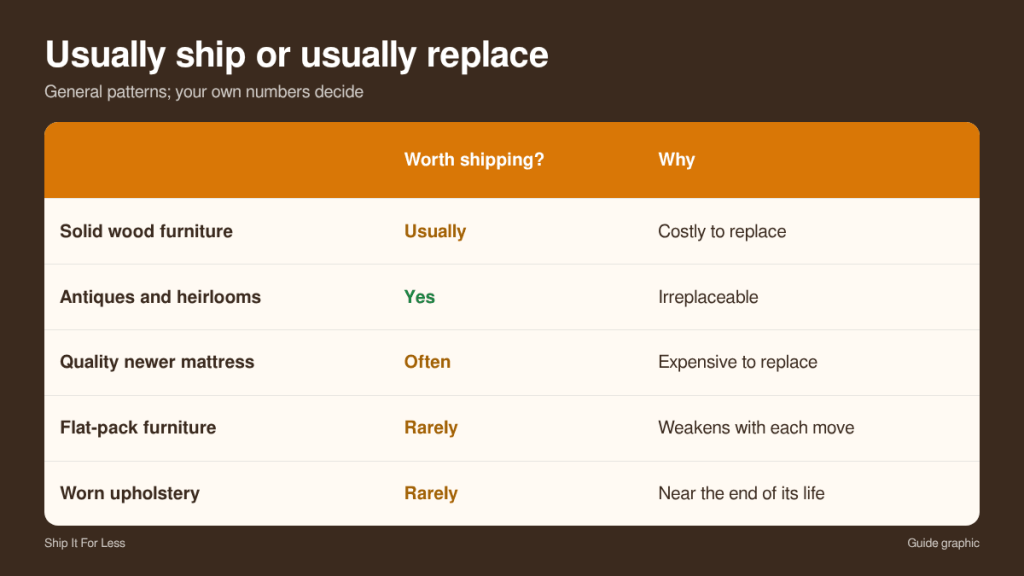
Items that are usually worth shipping
- Solid wood furniture in good condition
- Antiques, heirlooms and art
- Quality mattresses that are relatively new
- Well-made sofas and chairs you love
- Custom or hard-to-find pieces
- High-end appliances and home gym equipment in good condition
- Pianos and instruments with sentimental or musical value
Items that are usually better to sell or replace
- Flat-pack furniture, especially pieces already moved once
- Worn or stained upholstered furniture
- Older appliances, particularly if the new home already has them
- Large items that will not fit the new space
- Cheap shelving, plastic storage and basic patio furniture
- Items you have not used in a year
Timeline for deciding and selling
Good decisions take time. A simple timeline helps:
- Eight weeks out: walk through each room, list large items, and measure the new home.
- Seven weeks out: get freight quotes for the pieces you are likely to ship, so you know the real cost of keeping them.
- Six weeks out: make decisions for each piece and list items for sale.
- Four weeks out: schedule donation pickups for items that have not sold.
- Two weeks out: finalize the shipping list and book freight.
- Final week: hand off sold items, donate the rest, and pack what you are shipping.
Tips for selling and donating
- Price to sell. Used furniture sells faster at a realistic price, especially close to moving day.
- Take good photos. Clean the item, shoot in daylight and include measurements in the listing.
- Bundle sets. Dining sets, bedroom sets and patio sets often sell better together.
- Arrange donation pickups early. Charities often book pickups weeks in advance and may not accept stained, damaged or very large items.
- Keep records. Save receipts for donations, which may matter at tax time.
Shipping what you keep
- Consolidate everything you keep into one freight shipment where possible, so pieces travel together.
- Disassemble legs, shelves and headboards to reduce packed size.
- Pad furniture with blankets before stretch wrapping, and never put plastic directly on wood.
- Crate antiques and fragile pieces.
- Photograph each piece before packing and keep an inventory list.
Once you have cut the list down, ask for an updated freight quote based on the final items. Removing a few bulky pieces can noticeably change the packed size and density of the shipment, and the new quote should reflect it. Measure the packed pieces again on the day they are wrapped, since padding and crating add inches. Sending accurate final numbers to the carrier helps you avoid reweigh or reclassification charges after delivery, and it gives you a clean record of exactly what left your old home.
Frequently asked questions
Is it cheaper to ship furniture or buy new?
It depends on the piece. Quality and sentimental items are often worth shipping, while inexpensive or worn items are usually cheaper to replace.
Should I ship my mattress when I move?
If it is relatively new and in good condition, often yes. Older mattresses are usually better replaced.
How do I estimate shipping cost per item?
Ask for a freight quote listing each item’s size and weight, then divide the cost roughly by each item’s share of space or weight.
When should I start deciding what to move?
About eight weeks before the move gives you time to compare quotes, sell items and book freight.
Keeping your best pieces?
Get a quote for the furniture worth moving before you decide. The Postal Spot’s freight shipping service can pack and ship selected furniture from Houston.