

Ordinary packing supplies work well for most shipments, but they can quietly harm art and antiques. Newsprint transfers ink onto light surfaces. Bubble wrap pressed directly against a painting can leave a pattern in soft varnish. Colored tissue bleeds dye when it gets damp, and cheap foam breaks down and sticks to finishes. When an object is old, valuable or chemically sensitive, the materials that touch it matter as much as the box around it.
This guide explains the archival and conservation-grade packing materials that professional art handlers rely on, what each one is for, which materials should never touch fragile surfaces, and how to build a layered packing system for paintings, works on paper, textiles, ceramics and antique furniture.
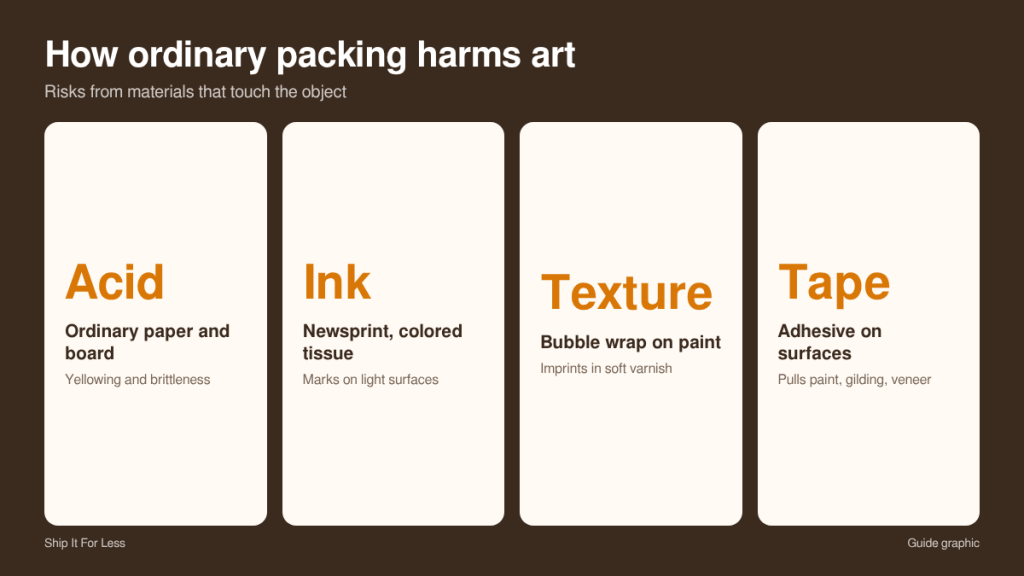
Why archival materials matter
“Archival” generally describes materials that are chemically stable and unlikely to harm the objects they touch over time. In packing, the goal is simple: anything in direct contact with the object should be clean, inert, non-abrasive and free of acids, dyes and adhesives that could transfer or react.
The most common risks come from:
- Acid. Ordinary paper and cardboard can contain acids that cause yellowing and brittleness over time on paper, textiles and some finishes.
- Ink and dye transfer. Newsprint and colored tissue can mark surfaces, especially when warm or damp.
- Texture imprinting. Bubble wrap and textured foams can press patterns into soft paint, varnish, wax or leather.
- Adhesives. Tape applied to surfaces can pull off paint, gilding or veneer, and leave residue.
- Trapped moisture. Plastic sealed tightly against wood or canvas can hold humidity, encouraging mold or finish damage.
The core archival packing materials
Acid-free tissue paper
Soft, unbuffered or buffered tissue used as the first layer on many objects. It is ideal for wrapping ceramics, silver, small sculpture and textiles, and for padding folds in fabric. For textiles made of protein fibers such as silk and wool, many conservators prefer unbuffered tissue, so check guidance for your object if you are unsure.
Glassine
A smooth, glossy, air- and grease-resistant paper. It is widely used as the first layer over paintings and framed works because it does not stick to or snag the surface. It should be acid-free and is not ideal for works with very soft or wet surfaces.
Polyethylene foam
Closed-cell polyethylene foam, in sheets, planks or rolls, is stable, cushioning and does not shed. It is used for padding corners, lining crates, building cradles and separating objects. It is a better long-term choice than many older or polyurethane foams, which can degrade.
Polyester batting and Tyvek
Polyester batting wrapped in a smooth, nonwoven sheet such as Tyvek makes soft pads and “pillows” for supporting irregular shapes. Tyvek also works as a dust and moisture barrier over objects without the sticking problems of plastic film.
Acid-free board and corrugated archival board
Rigid sheets used to back works on paper, make travel frames and build protective sleeves. They keep flat objects from flexing.
Cardboard corner protectors
For framed works, corner protectors keep the most vulnerable edges from taking impacts. Make sure the inside surface does not touch fragile gilding directly; add a layer of tissue or glassine first.
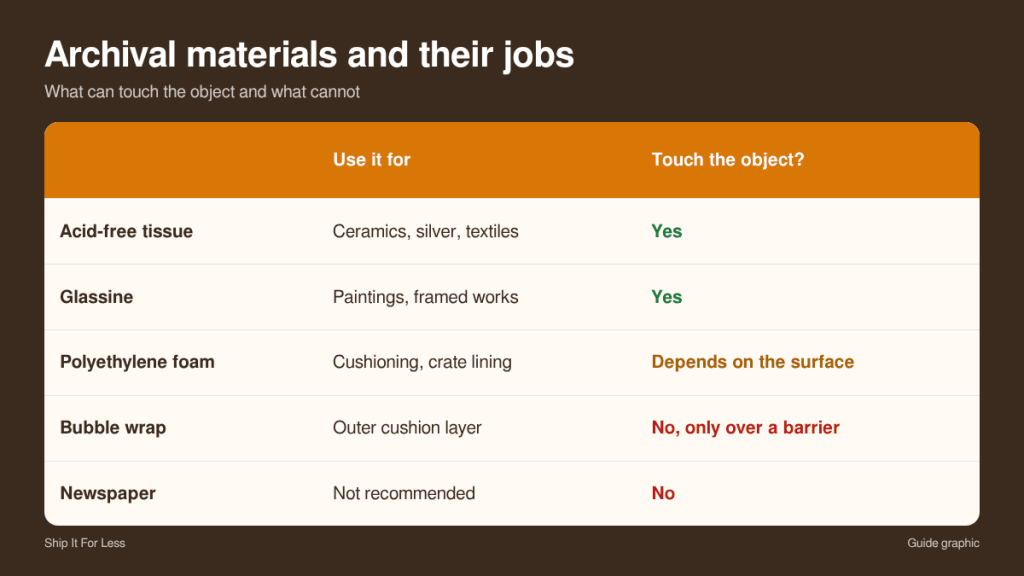
Materials that should never touch the object
- Newspaper. Ink transfers and acids react with surfaces.
- Bubble wrap directly on paint, varnish or leather. It can leave imprints and trap moisture. Use it only over a protective barrier layer.
- Packing peanuts directly around fragile items. Objects migrate through them during transit. Use them only as outer filler, if at all.
- Tape on any surface. Tape belongs on wrapping materials only, never on the object or its frame.
- Plastic film sealed against wood or canvas. Plastic can go over padding as an outer layer but should not seal in moisture against the object.
- Colored or printed tissue. Dye can bleed with humidity.
Layering: how professionals build a pack
Professional packing works in layers, each with its own job:
- Contact layer. Acid-free tissue or glassine that touches the object and protects the surface.
- Cushion layer. Polyethylene foam, padded batting or bubble wrap over the contact layer to absorb shock.
- Inner container. A snug box, travel frame or foam-lined case that keeps the object from moving.
- Outer cushioning. Foam or other filler around the inner container, typically at least 2 to 3 inches on every side.
- Outer container. A sturdy double-wall box or a wooden crate, labeled for orientation and handling.
Double boxing like this separates the object from impacts on the outer shell. For high-value or heavy items, a custom wooden crate replaces the outer box.
Packing approaches by object type
Paintings and framed art
- Cover the face with glassine, then add corner protectors.
- For glazed frames, put low-tack masking film or a taped X on the glass only if the shipper recommends it, since glass is safest when it cannot shatter into the image.
- Wrap in foam or bubble wrap over the glassine, then place in a snug box or a foam-lined crate.
Works on paper
Place prints, drawings and photographs between acid-free boards or in a rigid travel folder. Keep them flat and protect them from moisture with an outer barrier.
Textiles
Roll rugs, quilts and tapestries around an acid-free tube, interleaving with acid-free tissue. Pad folds with rolled tissue if folding is unavoidable. Wrap with Tyvek or washed cotton rather than plastic.
Ceramics, glass and sculpture
Wrap in acid-free tissue first, then foam or bubble wrap. Fill hollow interiors with tissue to support thin walls. Pack each piece in its own inner box before double boxing.
Antique furniture
Wrap with soft blankets or padding, never plastic directly on finishes. Protect corners, carvings and feet with foam. Remove marble tops, mirrors and glass panels and pack them separately.
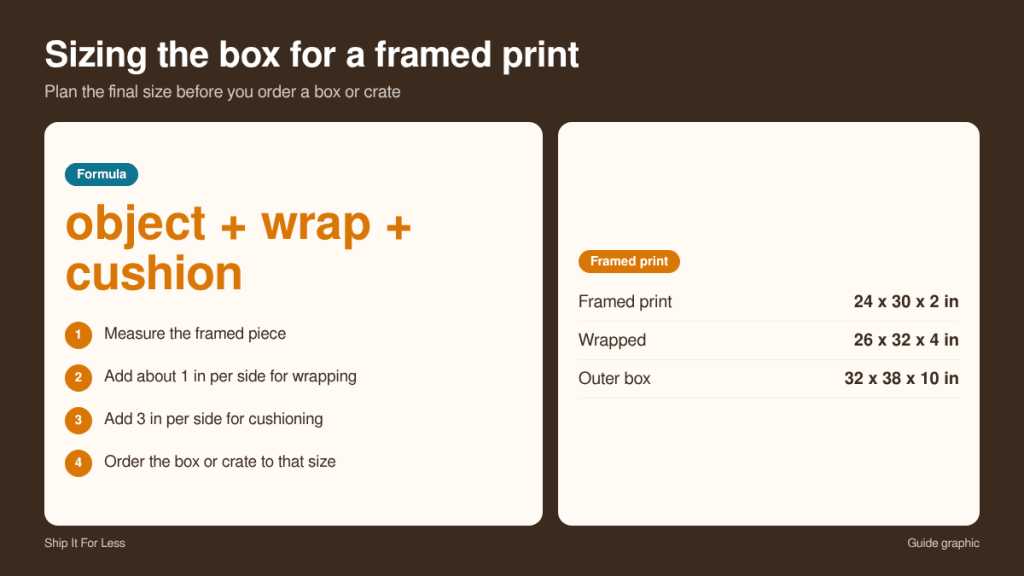
Worked example: packing a framed print
Suppose a framed print measures 24 x 30 inches and 2 inches deep. With glassine and two layers of foam adding about 1 inch on each side, the wrapped piece is about 26 x 32 x 4 inches. Add 3 inches of cushioning on every side inside the outer box, and the outer box needs to be about 32 x 38 x 10 inches. Planning the final size like this helps you order the right box or crate and get accurate shipping quotes.
A starter kit for packing valuables
If you ship art or antiques more than once in a while, keeping a small kit on hand makes it easier to pack correctly instead of grabbing whatever is nearby. A practical kit includes:
- A roll or pack of acid-free tissue, preferably unbuffered if you handle textiles.
- A roll of glassine for paintings and framed pieces.
- Polyethylene foam sheets in two thicknesses, plus a few foam planks for corners and blocking.
- Tyvek sheeting or washed cotton for dust covers.
- Acid-free board for backing flat works.
- Cardboard corner protectors in several sizes.
- Clean cotton or nitrile gloves, so oils from your hands do not mark metal, gilding or photographs.
- Double-wall boxes in a few common sizes, and good packing tape for the outside only.
- Labels for “Fragile,” “This Side Up” and “Do Not Stack.”
Store materials somewhere clean and dry. Tissue and foam that have picked up dust, grit or moisture in a garage can scratch or stain the objects they are meant to protect. If any material smells musty or looks discolored, replace it before using it on something valuable.
For very valuable, very large or structurally fragile pieces, professional packing is still the safer route, but the right materials at home help with smaller items and with preparing pieces before a shipper arrives.
Frequently asked questions
Is acid-free tissue necessary for shipping?
For paper, textiles, valuable ceramics and other sensitive pieces, it is strongly recommended because it is stable and will not transfer acids or dyes.
Can I use bubble wrap on a painting?
Not directly against the surface. Use glassine first, then bubble wrap or foam over it.
What foam is best for packing antiques?
Closed-cell polyethylene foam is a common choice because it is stable and does not shed.
Should antiques be wrapped in plastic?
Plastic should not touch the object or seal moisture against wood or canvas. It can be used as an outer layer over padding.
Want your piece packed with the right materials?
Leave the layers to people who pack fragile work every day. The Postal Spot packs and crates art and antiques in Houston for safe shipping.