

Handing a painting, a sculpture or a piece of antique furniture to a stranger is nerve-racking, and it should be. Fine art and antiques are often irreplaceable, and the difference between a careful shipper and a careless one shows up as cracked frames, flaking paint, split veneer or a missing crate. Price matters, but for valuable objects it is rarely the most important factor. The right shipper is the one whose packing, handling, insurance and communication match what the object needs.
This guide explains the main types of art and antique shippers, the questions to ask before you hire one, what good answers sound like, the red flags that should make you walk away, and how to compare quotes that are built in different ways. Use it whether you are shipping one inherited piece or a gallery’s worth of work.
Types of art and antique shippers
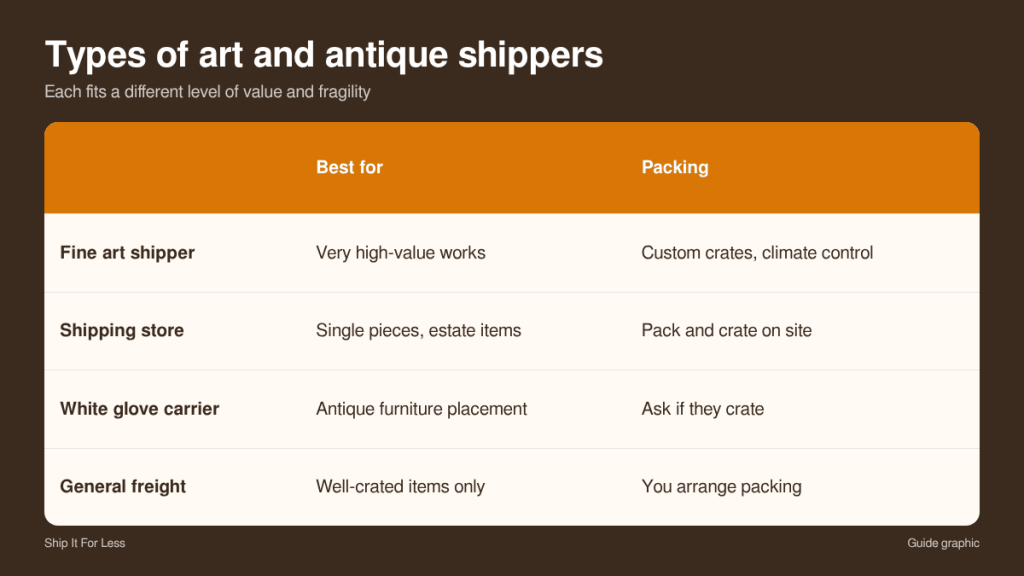
Specialized fine art shippers
Fine art logistics companies focus on museum, gallery and collector work. They typically offer climate-controlled trucks, two-person crews, custom crating and installation. They are the right choice for very high-value works, large installations or pieces that are especially sensitive to temperature and humidity.
Packing and shipping stores with antique services
Many local shipping stores offer professional packing, custom crating and access to freight carriers. They are often a practical fit for individual pieces, estate items, auction purchases and antiques of moderate to high value, especially when you want someone to pack the item in front of you.
White glove furniture carriers
White glove carriers specialize in inside delivery, placement and debris removal. They can be good for antique furniture, but ask whether they custom crate and how they handle fragile finishes.
General freight and parcel carriers
Standard LTL and parcel networks move freight through terminals with automated sorting and forklifts. They can carry well-crated antiques, but they do not pack items for you and their default liability is limited. Use them only with professional packing and adequate insurance.
Questions to ask about packing
Packing is where most damage is prevented or caused. Ask:
- Will you pack the item yourselves, and can I watch? A good shipper will pack in front of you or share photos of each stage.
- What materials do you use? Look for acid-free tissue, glassine for paintings, polyethylene foam, corner protectors and sturdy double-wall boxes or wooden crates.
- Do you build custom crates? Ask whether crates are sized to the object, padded with foam, and built with handles or skids for forklifts.
- How do you handle glass, frames and gilded surfaces? The answer should include taping or removing glass, protecting corners, and keeping materials from touching fragile surfaces.
- How do you pack furniture with veneer, marble or mirrors? Expect answers about removing marble tops and mirrors, padding before wrapping, and never putting plastic directly on wood.
Questions to ask about handling and transit
- How many times will the item be handled? Direct, dedicated transport means fewer handoffs than freight that passes through several terminals.
- Is the truck climate controlled? Important for paintings, musical instruments, wooden antiques and anything sensitive to heat and humidity.
- Will it be stacked or loaded with other freight? Ask for “Do Not Stack” handling and how it is enforced.
- Who does the pickup and delivery? A trained two-person crew or a single driver with a liftgate are very different experiences for a heavy antique.
- Is inside delivery and unpacking included? For valuable pieces, unpacking by the crew lets you inspect together.
Questions to ask about insurance and claims
Insurance is where many shippers are vague, so ask specifically:
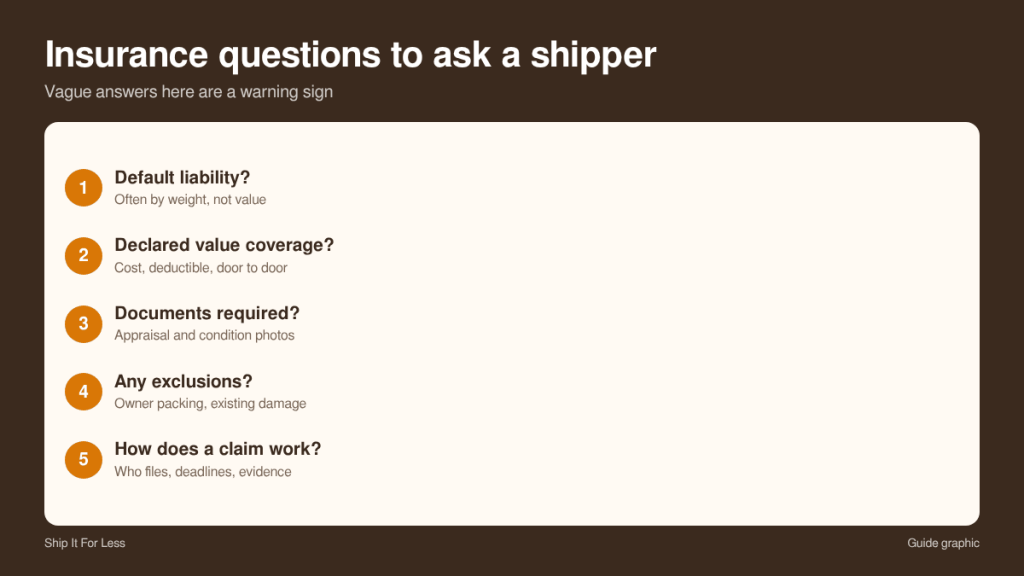
- What is your default liability? Many carriers limit liability by weight, not by value, which can be far less than the value of an antique.
- Can I buy coverage for the declared value? Ask how coverage is priced, what the deductible is and whether it covers the item door to door.
- What documentation do you require? Expect to need an appraisal or proof of value, plus condition photos before packing.
- Are there exclusions? Common ones include pre-existing damage, items packed by the owner, and inherent fragility such as old glass or brittle finishes.
- How does a claim work? Ask who files, how quickly damage must be reported and what evidence is needed.
Also check your own homeowner’s or collection policy. Some policies cover items in transit, and knowing that helps you decide how much additional coverage to buy.
Questions to ask about communication and timing
- Who is my point of contact from pickup to delivery?
- Will I receive tracking or status updates?
- How far in advance do you schedule pickup and delivery?
- What is the estimated transit time, and is it guaranteed?
- What happens if delivery has to be rescheduled?
Red flags to watch for
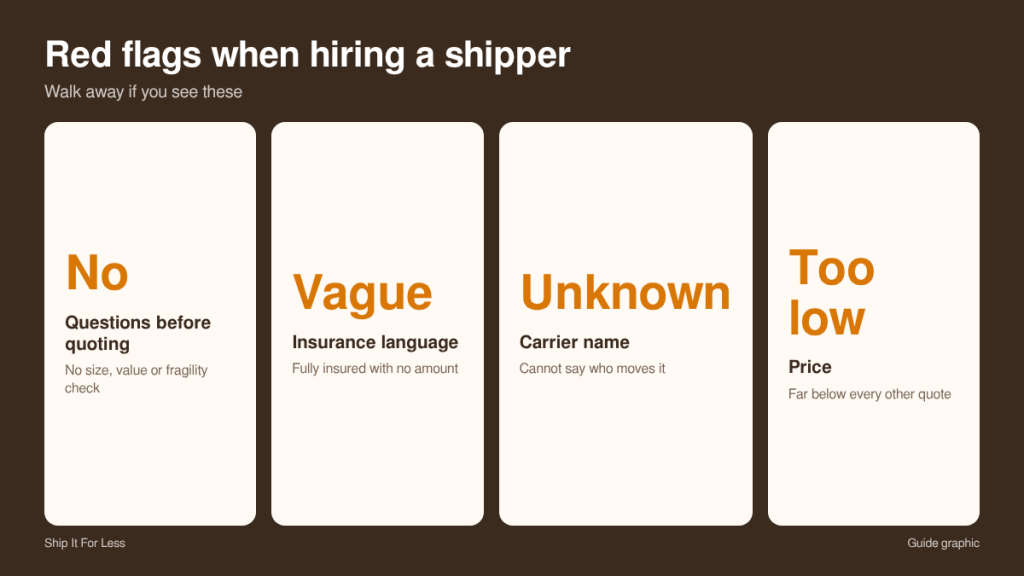
- A quote given without asking about size, weight, value or fragility.
- No clear answer on who will pack the item or how.
- Vague insurance language such as “fully insured” with no coverage amount.
- Reluctance to put the quote, services and coverage in writing.
- No ability to name the carrier that will actually move the item.
- A price far below every other quote, with no explanation.
How to compare quotes fairly
Art and antique quotes can differ because they include very different services. Put them side by side and check:
- Packing method: soft pack, double box or custom crate.
- Transport type: shared freight, dedicated truck or climate controlled.
- Pickup and delivery services: curbside, inside, unpacking, debris removal.
- Insurance: coverage amount, deductible and exclusions.
- Transit time and scheduling flexibility.
Worked example
Say you are shipping an antique cabinet appraised at $6,000. Quote A is lower but includes only carrier liability, which is weight based. If the cabinet weighs 150 pounds and the liability limit were, say, a few dollars per pound, the most you could recover would be a few hundred dollars. Quote B costs more but includes custom crating and declared value coverage for $6,000. Ask each shipper for its actual liability figure and coverage terms, then compare what you would recover if the worst happened, not just the upfront price.
Prepare before the shipper arrives
- Photograph the object from every angle, including close-ups of existing cracks, chips or wear.
- Gather appraisals, receipts or provenance documents.
- Measure the object and estimate its weight.
- Clear a path for the crew and note any stairs, elevators or tight turns.
- Tell the shipper about any known weaknesses, such as loose joints or flaking paint.
Write a simple condition report
A condition report is a short written record of the object’s state before it leaves. It does not need to be formal. For each item, note:
- A description, including maker, materials, approximate age and dimensions.
- Existing damage, with its location: “1 inch chip on lower left corner of frame,” “hairline crack in glaze near base.”
- Any repairs or restorations you know about.
- The number of parts, such as a cabinet with two doors, three shelves and a removable crest.
- The photo file names that match each note.
Ask the shipper to sign or acknowledge the report at pickup, and keep a copy for yourself. At delivery, the recipient can check the object against it line by line. If anything new appears, the report and photos make the difference between a quick claim and a disputed one.
Decide what travels separately
Some parts of an antique are safer shipped on their own: marble tops, mirror plates, glass shelves, finials, clock pendulums and lampshades. Discuss these with the shipper before pickup so they can be packed in their own boxes or secured separately inside the crate.
Frequently asked questions
Do I need a specialized fine art shipper?
For very high-value or sensitive works, often yes. For many antiques and individual pieces, a shipping store with professional packing and crating is a practical choice.
Is carrier liability enough for antiques?
Rarely. Default liability is often based on weight. Buy coverage for declared value if the item is valuable.
Should I pack the antique myself?
Professional packing is usually better, and some insurance excludes items packed by the owner.
What documents should I keep?
Keep the quote, bill of lading, condition photos, appraisal and insurance certificate until the item arrives safely.
Shipping a valuable piece from Houston?
Professional packing and the right coverage make the biggest difference. The Postal Spot’s antique shipping service includes custom crating and careful handling for art and antiques.