

Some equipment is simply too big, too tall or too heavy for an enclosed LTL trailer. Excavators, skid steers, scissor lifts, large generators, tanks, tractors and fabricated steel all tend to ride on open-deck trailers instead. The problem for first-time shippers is that open-deck freight comes in several trailer types, each with its own height, loading method and cost, and booking the wrong one can mean a truck that shows up and cannot legally carry your load.
This guide explains the main open-deck trailer types (flatbed, step deck, removable gooseneck and a few specialty options), how to choose based on your equipment’s size and how it loads, how permits and oversize rules come into play, and what information to gather before you request a quote.
Why open-deck trailers exist
Enclosed dry vans are ideal for palletized freight that a forklift can load through rear doors. Equipment often cannot load that way. It may need to be driven on, lifted on by crane from above, or loaded from the side. It may also be taller than a van’s interior. Open-deck trailers solve that by giving you a flat platform that can be loaded from any direction.
The trade-off is exposure. Freight on an open deck faces wind, rain and road grime, so it must be tarped or shrink-wrapped if it is sensitive, and it must be secured with chains or straps according to cargo securement rules.
Flatbed trailers
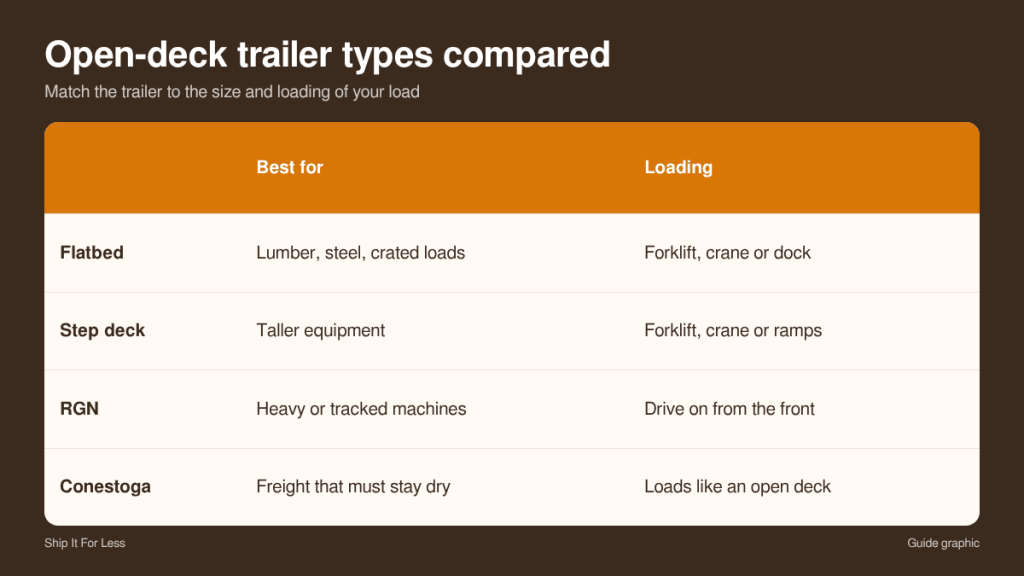
A standard flatbed is a single flat deck, commonly 48 or 53 feet long. It is the most widely available open-deck trailer and usually the most affordable option.
- Best for: lumber, steel, building materials, pipe, crated machinery and equipment that is not especially tall.
- Loading: forklift or crane from the sides or top, or a loading dock at the right height.
- Limitations: the deck sits relatively high off the ground, so tall equipment can push the overall height past legal limits. Drive-on loading usually requires ramps or a dock.
Step deck trailers
A step deck (also called a drop deck) has a short upper deck over the truck’s fifth wheel and a longer lower deck behind it. The lower deck sits closer to the road than a standard flatbed.
- Best for: taller equipment that would be over height on a flatbed, such as tractors, small excavators, scissor lifts and some vehicles.
- Loading: forklift or crane, and many step decks carry ramps for driving equipment on.
- Limitations: the lower deck is shorter than a full flatbed, and the step can limit how long items are positioned.
Removable gooseneck (RGN) trailers
An RGN has a front section (the gooseneck) that detaches so the front of the trailer drops to the ground, forming a ramp. Equipment drives straight onto a very low deck.
- Best for: heavy, tall or tracked equipment such as bulldozers, larger excavators and cranes, and loads that cannot be lifted.
- Loading: drive-on from the front, without separate ramps.
- Limitations: RGNs are less common and usually cost more than flatbeds or step decks. Very heavy RGN loads may require extra axles and special permits.
Other options worth knowing
Hotshot trailers
A hotshot is a smaller gooseneck flatbed pulled by a heavy-duty pickup. It works well for a single skid steer, compact tractor, small lift or a few pallets of equipment that need to move quickly, and it can reach sites that a full-size semi cannot.
Conestoga trailers
A Conestoga is a flatbed or step deck with a sliding, rolling tarp system. It loads like an open deck but protects freight like an enclosed trailer, which suits machinery and finished goods that should stay dry.
Lowboys and multi-axle trailers
For very heavy or oversized machinery, specialized lowboys and multi-axle trailers spread weight across more axles. These moves are usually planned with route surveys and permits well in advance.
How to choose the right trailer
Answer these questions about your equipment and the trailer choice usually becomes obvious:
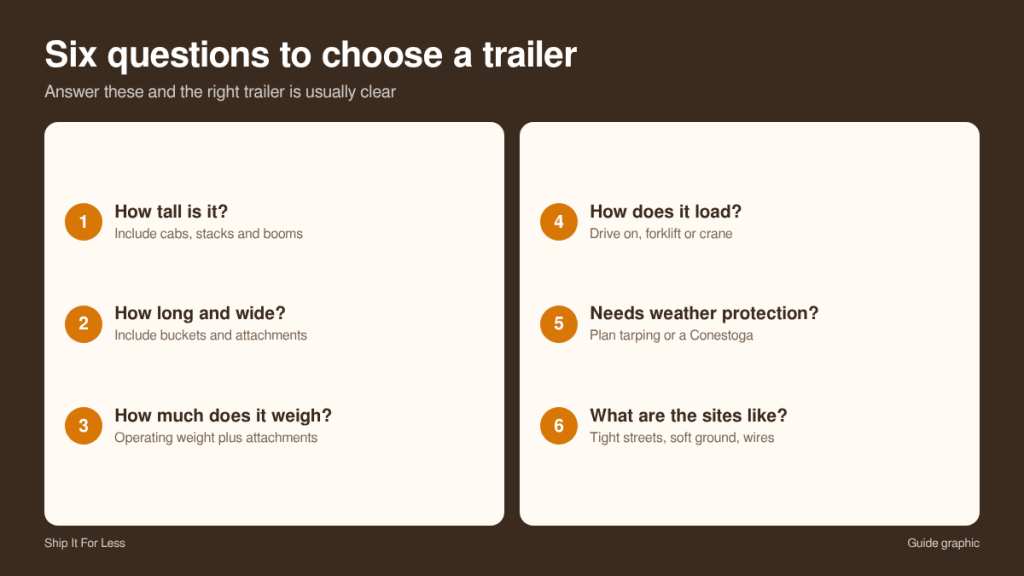
- How tall is it? Measure to the highest point, including cabs, exhaust stacks, booms or roll cages.
- How long and wide is it? Include buckets, attachments and anything that sticks out.
- How much does it weigh? Use the operating weight from the spec sheet, plus attachments and any fuel or fluids.
- How does it load? Can it drive or track on? Does it need a forklift or crane? Is there a dock at either end?
- Does it need protection from weather? If so, plan for tarping or a Conestoga.
- Where is the pickup and delivery site? Tight residential streets, soft ground or low wires can rule out some trailers.
Worked height example
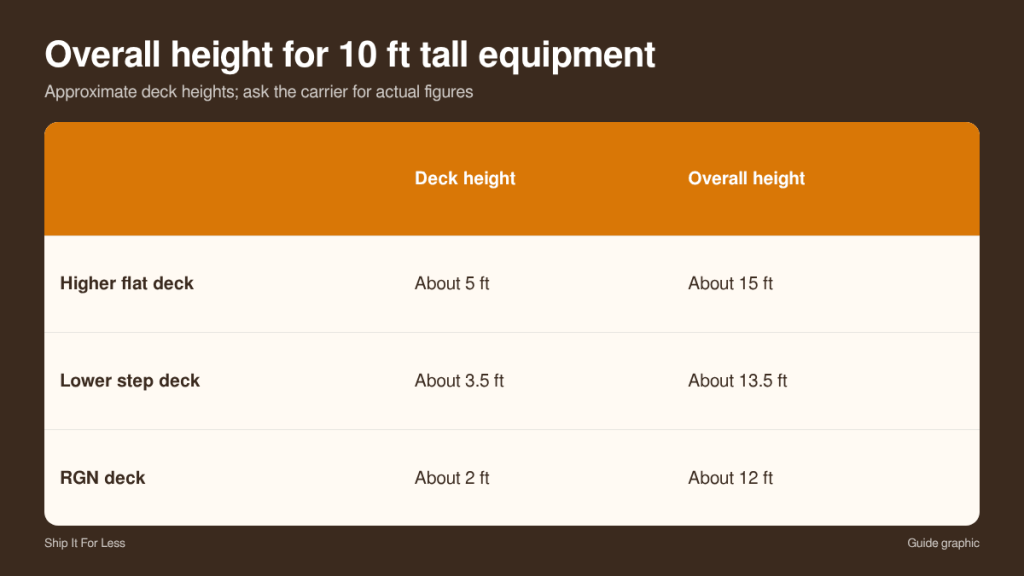
Say your equipment is 10 feet tall. On a trailer deck that sits about 5 feet off the road, the overall height is roughly 15 feet. On a lower deck that sits about 3.5 feet off the road, the overall height drops to roughly 13.5 feet. On an RGN deck that sits about 2 feet off the road, it is about 12 feet. Compare those totals with the legal height limits on your route. Deck heights vary by trailer, so ask the carrier for the actual figure before booking.
Permits, oversize loads and securement
- Width. Loads wider than the standard legal width (generally 8.5 feet on most highways) are considered oversize and need permits.
- Height and weight. Each state sets legal height and weight limits. Loads beyond them need permits, and very large loads may need escort vehicles or specific travel times.
- Multi-state moves. Permits are issued state by state, so a load crossing several states needs a permit for each. Your carrier or broker typically arranges these.
- Securement. Equipment must be chained or strapped according to federal cargo securement rules, with attachments lowered and secured and moving parts locked.
Preparing equipment for open-deck transport
- Clean off mud and debris so nothing blows off on the highway and so you can document condition.
- Photograph every side, plus the hour meter and any existing damage.
- Lower booms, buckets and blades, and secure or remove loose attachments.
- Disconnect the battery if the manufacturer recommends it, and close fuel valves.
- Cover exhaust openings and protect gauges and seats from wind and rain.
- Note tie-down points so the driver can secure the machine quickly and correctly.
What to include in your quote request
Open-deck quotes depend heavily on details, so give the carrier or broker everything up front:
- Make, model and year of the equipment, plus a link to or copy of the spec sheet.
- Length, width and height in feet and inches, measured with attachments in their transport position.
- Operating weight, plus the weight of any attachments shipping with it.
- Whether it runs and can drive on, or whether it needs a forklift, crane or winch.
- Pickup and delivery addresses, and whether each has a dock, a forklift, level ground and room for a long trailer to turn.
- Any need for tarping, and the date the equipment must arrive.
- Photos of the machine from several angles, which help the carrier spot problems before the truck is dispatched.
A complete request lets the carrier choose the right trailer the first time, which avoids a costly dry run where a truck arrives and cannot load.
Frequently asked questions
What is the difference between a flatbed and a step deck?
A flatbed has one flat deck at a single height. A step deck has a lower rear deck, which lets taller equipment fit under legal height limits.
When do I need an RGN trailer?
When equipment is heavy or tall and needs to drive on, such as tracked machines, or when a step deck would still be over height.
Do I need a permit to ship equipment?
Only if the load exceeds legal width, height, length or weight limits on the route. Carriers usually arrange permits for oversize loads.
Can open-deck freight be protected from rain?
Yes. Ask for tarping or shrink wrap, or book a Conestoga trailer with a rolling tarp system.
Shipping equipment that will not fit in a van?
The Postal Spot arranges freight for oversized equipment from Houston and can help match your load to the right trailer type.