

The first time you need to ship something on a pallet, you quickly run into two kinds of companies offering to move it: freight carriers that own trucks and terminals, and freight brokers or shipping agents that arrange the move on your behalf. Both can get your sofa, machine or crate from one city to another, but they work very differently, and choosing the wrong one can mean higher costs, slower answers or a confusing claims process.
This guide explains what carriers and brokers actually do, how money and responsibility flow between them, when each one is the better fit, and the questions to ask before you hand over your shipment. It is written for homeowners, small businesses and occasional shippers who do not have a logistics department to lean on.
What a freight carrier does
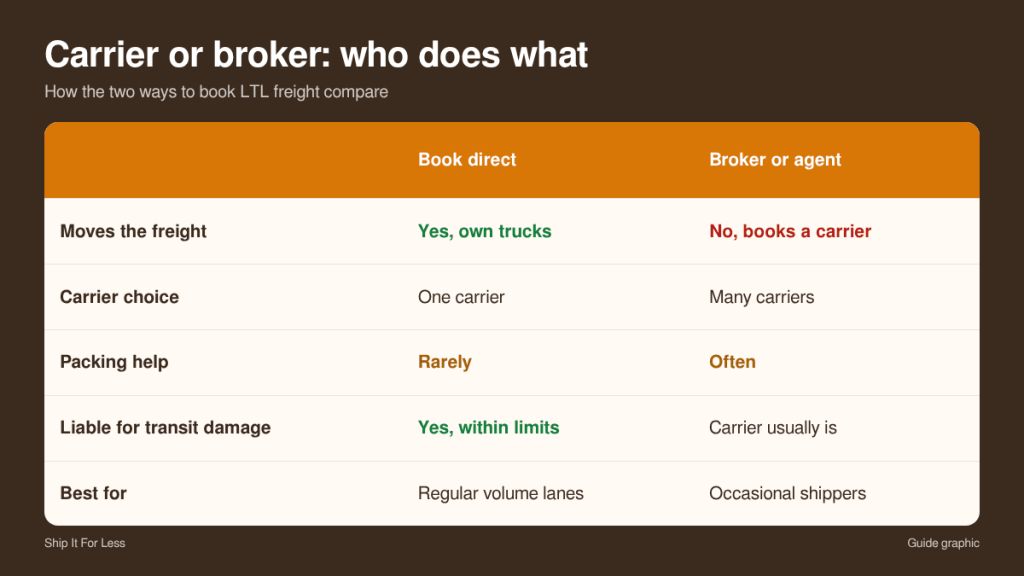
An LTL (less-than-truckload) carrier is the company that physically moves your freight. It owns or leases the trucks, employs the drivers and dock workers, and runs a network of terminals where shipments are unloaded, sorted and reloaded onto trucks heading toward their destination.
When you book directly with a carrier, you are dealing with the company that will touch your freight from pickup to delivery. That has some clear advantages:
- One point of contact. The company that quotes you is the company that tracks, delivers and handles any claim.
- Direct tracking. You see the carrier’s own status updates, terminal scans and delivery appointments.
- Negotiated pricing for steady volume. Businesses that ship regularly can earn contract pricing that improves with volume.
The trade-off is coverage and choice. Each carrier has strong lanes and weak lanes. A carrier that is fast and affordable between Houston and Dallas may be slow or expensive to a rural address in another region, and you will only find out by requesting quotes from several companies yourself.
What a freight broker or shipping agent does
A freight broker does not move the freight. Instead, it has agreements with many carriers and books your shipment with whichever one fits the lane, the timing and your budget. Retail shipping stores that offer freight often work the same way, acting as an agent that compares carriers and books the shipment for you.
Using a broker or agent changes the experience in several ways:
- Many carriers, one quote request. You describe the shipment once and get options from multiple carriers instead of calling each one.
- Access to pricing you may not get alone. Brokers that move a lot of freight often hold rates that an occasional shipper could not negotiate.
- Help with the paperwork. A good broker helps you choose the right freight class, accessorial services and bill of lading details.
- Extra services. Some agents also pack, palletize or crate the freight, which is valuable if you do not have the materials or a forklift.
The main risk is quality. A broker is only as good as the carriers it uses and the accuracy of the information it passes along. A broker who books the cheapest carrier without checking its service to your destination can leave you with a late or mishandled delivery.
How money and responsibility flow
Understanding who pays whom, and who is responsible for what, helps you avoid surprises.
Booking direct with a carrier
You pay the carrier, the carrier moves the freight, and any claim goes straight to the carrier. Carrier liability for LTL freight is usually limited and often based on weight rather than the value of the item, so high-value freight needs added cargo insurance either way.
Booking through a broker or agent
You pay the broker, and the broker pays the carrier. The carrier still moves the freight and still carries the legal liability for loss or damage in transit. The broker’s role in a claim is usually to help you file it and follow up with the carrier. Ask any broker to explain exactly how it supports claims, and whether it offers cargo insurance for declared value.
When to book directly with a carrier
Booking direct tends to make sense in these situations:
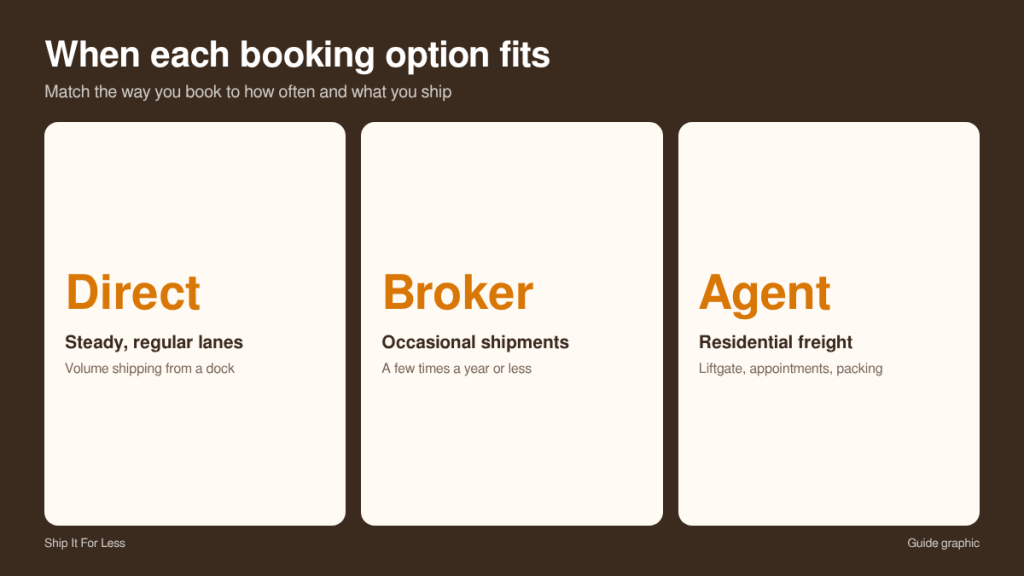
- You ship the same lanes regularly and can build a relationship with one or two carriers.
- You already know freight class, dimensions and accessorial needs, so you do not need guidance.
- Your shipping volume is large enough to earn contract rates.
- You have a loading dock and staff who handle pickups and paperwork.
A distributor that sends several pallets a week from a warehouse with a dock is a classic direct-carrier shipper. It benefits from consistency more than from comparing every shipment.
When a broker or shipping agent is the better choice
For most occasional and residential shippers, a broker or agent is the practical choice:
- You ship freight a few times a year or less.
- The pickup or delivery is residential and needs a liftgate, appointment or inside delivery.
- You need help packing, palletizing or crating before pickup.
- You want to compare multiple carriers without calling each one.
- The destination is unusual, rural or far outside one carrier’s strongest region.
Consider a worked example. You need to ship a crated antique cabinet from Houston to a small town four states away. Calling carriers directly, you would need to request four or five separate quotes, then work out which ones actually service that town without a long transfer to a partner carrier. A broker can quote several carriers at once, flag which ones deliver to that zip code directly, and add residential and liftgate service correctly the first time.
How to evaluate a freight broker or agent
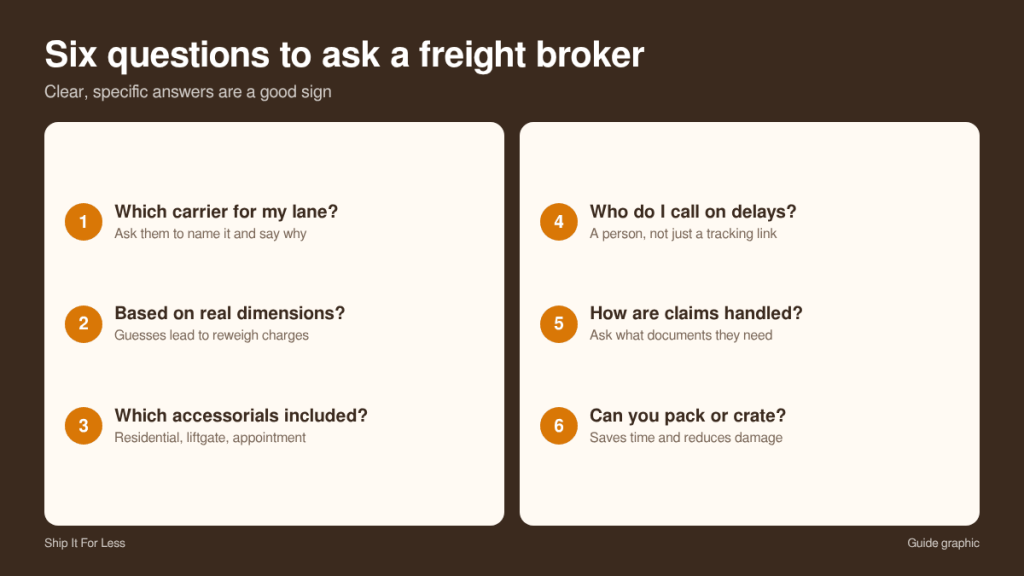
Before you book, ask these questions and listen for clear, specific answers:
- Which carriers will you use for my lane? A good agent can name the carrier on the quote and explain why it was chosen.
- Is the quote based on my actual dimensions and weight? Quotes built on guesses lead to reweigh and reclassification charges later.
- Which accessorial services are included? Residential delivery, liftgate, appointment and inside delivery should be listed, not assumed.
- Who do I call if the freight is delayed? You want a person who will check with the carrier for you, not just a tracking link.
- How do you handle damage claims? Ask what documentation they need and how they support the process.
- Can you pack or crate the freight? If you lack materials or equipment, this can save a lot of time and reduce damage risk.
Red flags to watch for
- A quote that is dramatically lower than every other quote with no explanation.
- Vague answers about which carrier will actually move the freight.
- No questions about dimensions, weight or delivery location before quoting.
- Pressure to pay before you have a written quote listing services.
Information to have ready either way
Whether you book direct or through an agent, you will get a faster and more accurate quote if you have these details ready:
- Pickup and delivery addresses, including whether each is residential or commercial.
- Packed dimensions (length, width and height in inches) and total weight, including the pallet or crate.
- A description of the item and whether it is fragile, high value or stackable.
- Whether either location has a loading dock or needs a liftgate.
- Any delivery timing needs, such as a move-in date or business hours only.
- The value of the item, so you can decide whether to buy added insurance.
From the dimensions and weight you can also work out density, which drives freight class under the density-based NMFC system that took effect July 19, 2025. For example, a pallet that measures 48 x 40 x 50 inches is 96,000 cubic inches, or about 55.6 cubic feet. At 500 pounds, that is a density of about 9 pounds per cubic foot. Sharing accurate numbers like these up front prevents most billing corrections.
Frequently asked questions
Is a freight broker more expensive than booking direct?
Not necessarily. Brokers earn a margin, but their volume pricing often offsets it. For occasional shippers, a broker quote is frequently competitive with or lower than a direct carrier quote.
Who is liable if my freight is damaged when I use a broker?
The carrier that moved the freight is usually liable for loss or damage in transit, subject to its liability limits. The broker typically helps you file and follow the claim.
Can a shipping store book LTL freight for me?
Yes. Many shipping stores act as freight agents, comparing carriers and booking the shipment, and some also pack and crate the items before pickup.
Do I need a business account to ship freight?
No. Individuals ship freight regularly. A broker or agent is often the easiest route if you do not have an account with a carrier.
Want someone to compare carriers for you?
The Postal Spot books LTL freight in Houston with 40+ carriers and can pack, palletize or crate your shipment before it leaves.