

An LTL freight quote looks simple at first glance: a carrier name, a transit time and a total. But that total is built from a dozen assumptions about your shipment, and if any of them are wrong, the invoice you receive after delivery can look very different from the number you agreed to. Reweigh charges, reclassification, missed liftgate fees and residential surcharges are almost always traceable to something on the quote that nobody checked.
This guide walks through an LTL freight quote line by line, explains what each section means, shows you how to compare quotes from different carriers fairly, and gives you a checklist to run before you click book. Use it whether you are shipping one pallet of furniture or a crate of equipment.
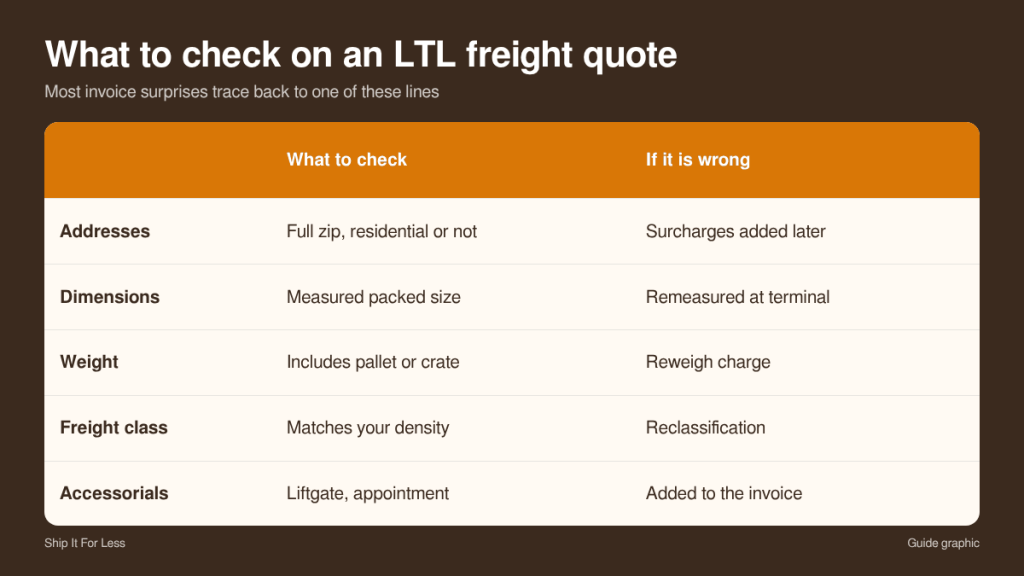
The shipment details section
Every quote starts with the information you or your agent entered. This is the part most worth checking, because everything else is calculated from it.
Origin and destination
Check the full addresses and zip codes, not just the cities. A different zip code can mean a different terminal, a remote-area charge or a partner carrier. Confirm whether each location is marked residential or commercial. A home business, a farm or a storage facility may be treated as residential or limited access even if you think of it as a business.
Dimensions and weight
The quote should list the length, width and height of each handling unit (pallet or crate) and the total weight including packaging. If the quote says 48 x 40 x 48 inches and your packed crate is actually 60 inches tall, the carrier will measure it at the terminal and bill you for the difference.
Handling units and pieces
The number of pallets or crates matters. Two pallets of 300 pounds each are handled differently than one pallet of 600 pounds, and the quote should match how the freight will actually be packed.
Commodity description and freight class
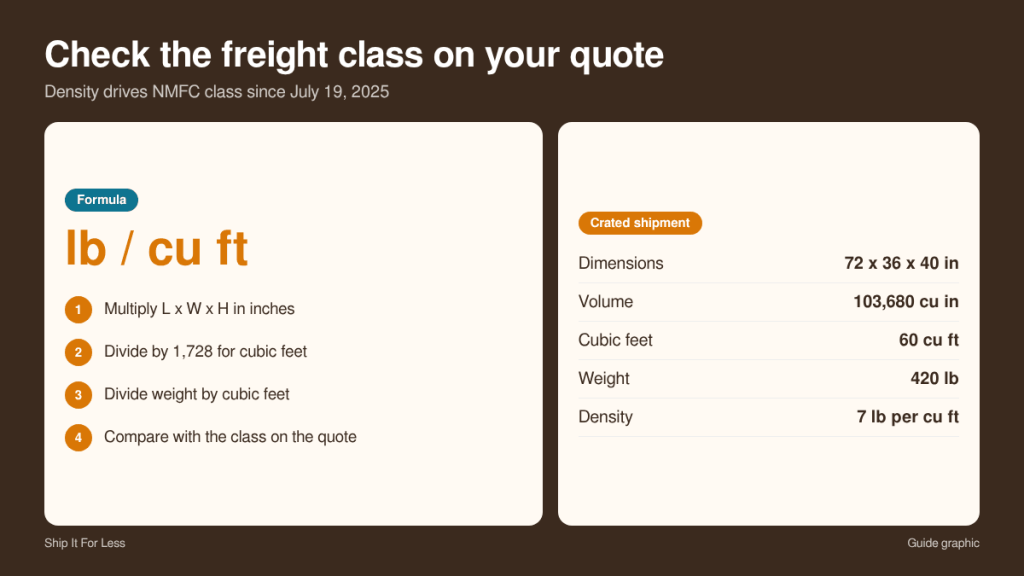
The description tells the carrier what the freight is, and the class tells it how to price it. Since July 19, 2025, NMFC freight classification for most commodities is based on density, using a 13-level density scale. The quote’s class should match the density you calculated from accurate dimensions and weight.
How to check the freight class on a quote
You can verify density yourself in three steps:
- Multiply length x width x height in inches.
- Divide by 1,728 to convert cubic inches to cubic feet.
- Divide total weight by cubic feet.
Example: a crate measuring 72 x 36 x 40 inches is 103,680 cubic inches. Divided by 1,728, that is 60 cubic feet. If the crate weighs 420 pounds, density is 420 divided by 60, or 7 pounds per cubic foot. If your quote lists a class that assumes a much higher density, the shipment is likely to be reclassified after a terminal inspection.
The pricing section
Base rate or linehaul
The base rate covers moving the freight from origin to destination. It depends on distance, lane, weight, class and the carrier’s tariff or your negotiated pricing. Some quotes show this as a gross rate and a discount; what matters is the net amount you pay.
Fuel surcharge
Most carriers add a fuel surcharge that changes with fuel prices. It is usually shown as a separate line or a percentage. When comparing quotes, include it, because one carrier’s lower base rate can be offset by a higher fuel line.
Accessorial charges
Accessorials are added services or conditions beyond standard dock-to-dock freight. Common ones include:
- Residential pickup or delivery
- Liftgate at pickup or delivery
- Delivery appointment or notification call
- Inside delivery
- Limited access locations, such as schools, churches, military bases or construction sites
- Extreme length or overlength for long items
The key question is not just what is listed, but what is missing. If the delivery is to a house without a dock and the quote does not include a liftgate, expect it to be added later.
Insurance or declared value
Carrier liability for LTL freight is limited, often based on weight and class rather than the actual value of your item. If the quote offers added cargo insurance, check the coverage amount, the deductible and what documentation a claim requires.
The service section
- Carrier name. Know who will actually move your freight, so you can track it and contact them.
- Estimated transit time. Usually in business days, not including weekends, holidays or appointment scheduling.
- Service level. Standard, guaranteed or expedited. Guaranteed service costs more and has specific terms.
- Quote validity. Many quotes expire after a set period. If you book later, rates may change.
- Direct or interline. Some quotes involve handing freight to a partner carrier for the final leg, which can add time.
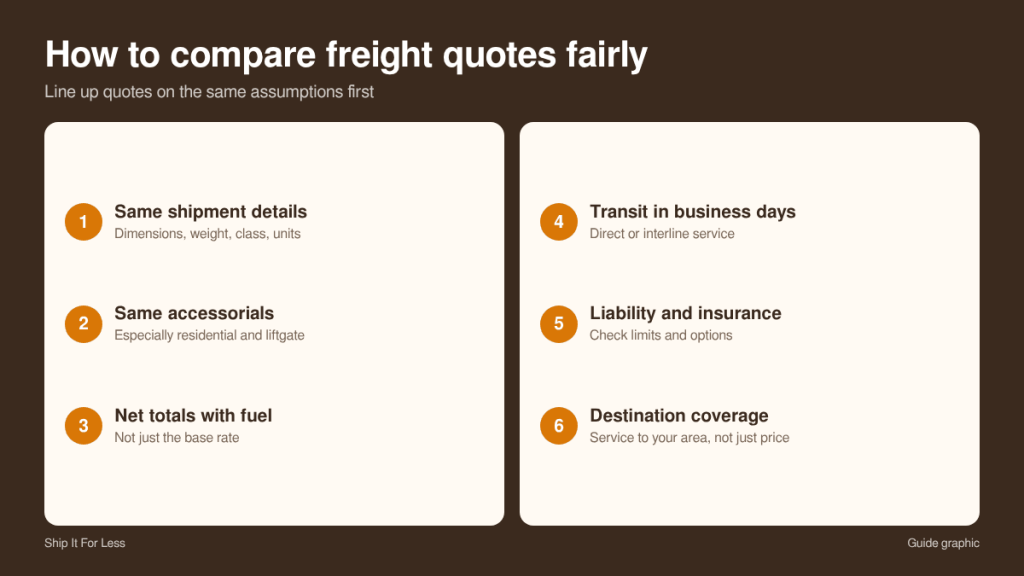
How to compare two or more quotes fairly
Comparing totals only works if every quote is built on the same assumptions. Line them up using this approach:
- Confirm each quote uses the same dimensions, weight, class and handling unit count.
- Confirm each quote includes the same accessorials, especially residential and liftgate.
- Compare net totals including fuel, not just base rates.
- Compare transit times in business days, and note whether service is direct or interline.
- Check liability limits and insurance options.
- Consider the carrier’s service to your destination area, not just the price.
A quote that looks low because it is missing a liftgate is not actually cheaper. Once you add the missing services, the ranking often changes.
Pre-booking checklist
Before you accept a freight quote, confirm each of these:
- Addresses and zip codes are complete and correct.
- Residential or commercial status is right for both ends.
- Dimensions and weight are measured from the packed freight, not estimated.
- Freight class matches your density calculation.
- Every needed accessorial is included.
- Contact names and phone numbers are correct for pickup and delivery.
- You understand the liability limit and have bought insurance if needed.
- You have saved the quote number and know when it expires.
Keep the quote with your bill of lading. If the invoice differs, the quote is your reference for asking the carrier or agent to explain the change.
A sample quote review, step by step
Here is how a quick review might look for a common shipment: a crated cabinet going from a Houston house to a relative’s home in another state.
- Addresses: Both ends are homes, so both should be marked residential. The quote shows the destination as commercial. That needs correcting, or a residential charge will be added after delivery.
- Dimensions: The quote lists 48 x 40 x 48 inches, but the crate was built at 72 x 36 x 40 inches. Update the dimensions so class and space are priced correctly.
- Weight: The quote shows the cabinet weight only. Add the crate and pallet weight so the total matches what the terminal scale will read.
- Accessorials: Neither home has a loading dock, so liftgate service is needed at pickup and delivery. Only delivery liftgate is listed. Add pickup liftgate too.
- Insurance: The cabinet is a family piece with real value. The default liability limit is weight based, so added coverage for declared value is worth considering.
After those corrections, the quote total will probably rise, but the final invoice will match it. That predictability is the real goal of reading a quote carefully.
Frequently asked questions
Why did my freight invoice come in higher than the quote?
The most common reasons are reweighing, reclassification after remeasurement, and accessorial services that were needed but not on the original quote, such as a liftgate or residential delivery.
Is the lowest LTL freight quote always the best?
No. Check that it includes the same services and accurate shipment details as the others, and consider transit time and the carrier’s coverage of your destination.
Do freight quotes include fuel surcharges?
Most do, either as a separate line or built into the total. Ask if it is not clear, because fuel can be a meaningful part of the cost.
How long is an LTL freight quote valid?
It varies by carrier and broker. Check the expiration on the quote and request an updated one if you book after that date.
Not sure your quote is complete?
Have someone review the details before you book. Get an LTL freight quote in Houston that is built on measured dimensions and the services you actually need.