

When you are moving long distance without hiring a full-service moving company, three do-it-yourself options usually come up: a portable moving container dropped at your driveway, freight shipping where your belongings ride on pallets with a carrier, and a rental truck you load and drive yourself. Each one can work well, and each one can be the wrong choice depending on how much you are moving, how far, how quickly, and how much labor you are willing to do.
This guide compares the three options side by side: how each works, what drives the cost, how much space and effort each requires, which risks to plan for, and a simple method for deciding which fits your move. It also includes a worked example to help you estimate how much space your belongings need.
How each option works
Portable moving containers
A company drops a container at your home. You load it over a few days, the company picks it up and transports it, and it is delivered to your new address, where you unload it. Many companies also offer storage in their facility between pickup and delivery.
Freight shipping
Your belongings are boxed and packed onto pallets or into crates, then shipped by an LTL carrier. You can load at home with a liftgate pickup, or bring packed items to a shipping location. At the destination, freight is delivered to your door or held at the terminal for you to collect.
Rental truck
You rent a truck, load it yourself or with hired labor, drive it to your new home and unload it. You control the schedule, but you also handle all the driving, fuel, parking and return.
Comparing the key factors
Volume
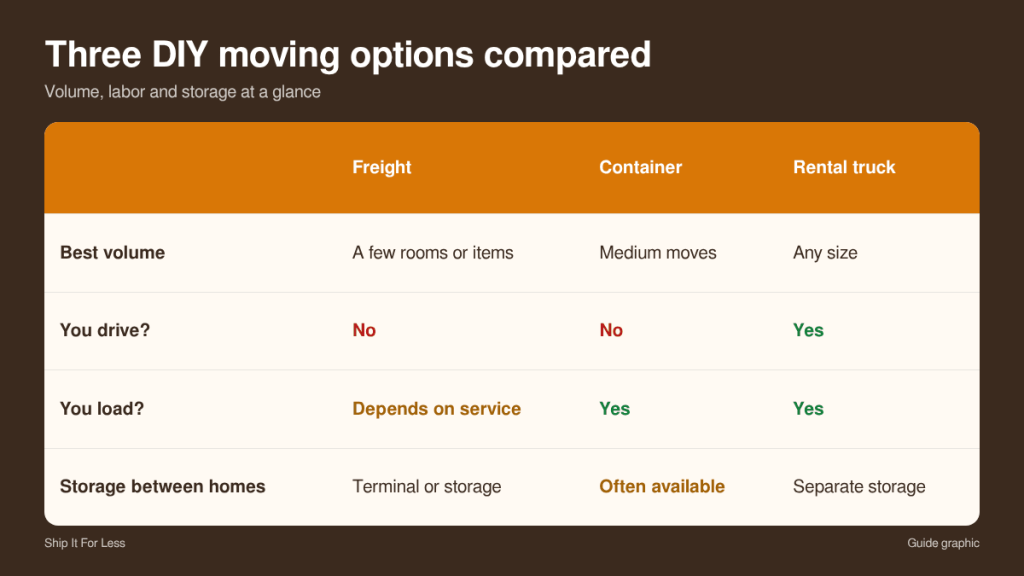
- Freight works best for small to medium moves: a studio, a few rooms of furniture, or selected large items plus boxes.
- Containers suit medium moves and come in a few fixed sizes. You may need more than one for a larger home.
- Rental trucks handle the widest range, from small trucks for an apartment to large trucks for a full house.
Labor
- Freight: you pack and help palletize, or have a shipping service pack and palletize for you. Carriers move the pallets.
- Containers: you load and unload, but there is no driving.
- Rental truck: you load, drive and unload, or hire help for loading and unloading.
Timing and flexibility
- Freight: transit times are estimates and vary by lane. You can ship ahead of your move.
- Containers: you get loading days, and storage is often available, which helps if your new home is not ready.
- Rental truck: fastest when you drive straight through, but you must arrive when your new place is ready, or pay for storage.
Space at the origin and destination
- Freight: a liftgate truck needs street access, but pallets do not need to stay on your property.
- Containers: you need a driveway or permitted street space for the container. Some apartment complexes and homeowners associations restrict them.
- Rental truck: you need space to park a large truck at both ends, sometimes overnight.
What drives cost
Prices vary widely by route, season and company, so rather than guessing at numbers, focus on what moves each price:
- Freight: weight, packed dimensions and density, distance, residential delivery, liftgates and any packing or crating services.
- Containers: container size and number, distance, storage time and delivery access.
- Rental truck: truck size, distance, mileage, fuel, insurance, equipment rental such as dollies and pads, and any hired labor.
Risks to plan for
- Freight: pallets are handled with forklifts at terminals, so packing quality matters. Buy added coverage for valuable items, since carrier liability is often limited.
- Containers: poorly loaded containers shift on the road. Load heavy items low, fill gaps and tie loads off in sections.
- Rental trucks: driving a large truck long distances is tiring and demands care on highways, in parking lots and under low clearances. Check what the rental insurance covers.
A simple decision framework
Answer these questions and the best option usually becomes clear:
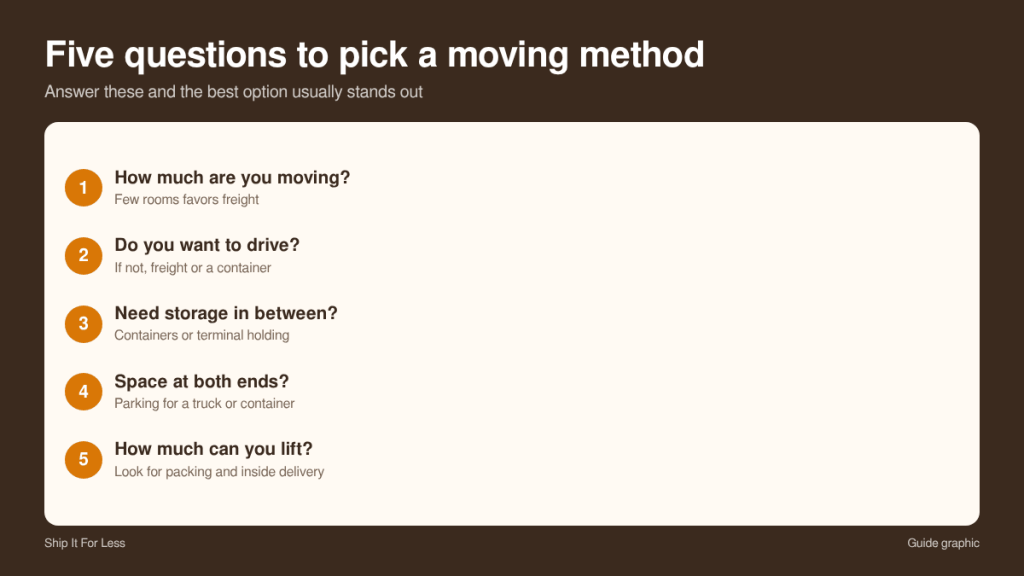
- How much are you moving? If it is only a few rooms or a handful of large items, freight is often the most practical. For a full house, containers or a truck usually make more sense.
- Do you want to drive? If not, freight or a container avoids the long drive.
- Do you need storage in between? Containers with storage, or freight held at a terminal or storage facility, help with gaps.
- Do you have space at both ends? If a container or truck cannot park at your new place, freight with liftgate delivery may be easier.
- How much labor can you do? If lifting is limited, look for freight with packing and palletizing included, and inside delivery at the destination.
Worked example: estimating space
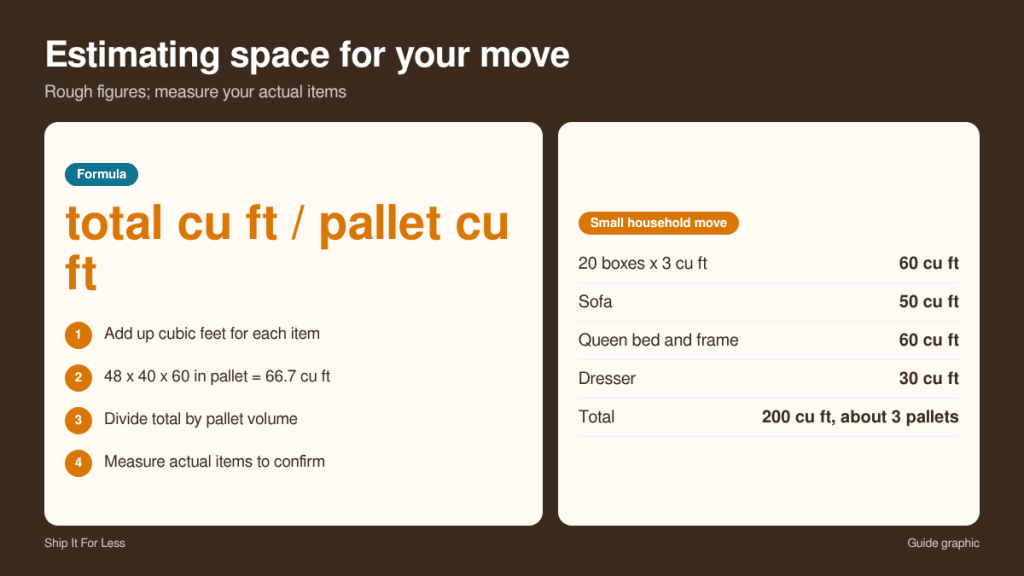
Freight, containers and trucks all depend on how much space your belongings take. A rough way to estimate is to add up cubic feet.
- Twenty medium boxes at about 3 cubic feet each: 20 x 3 = 60 cubic feet.
- A sofa at about 50 cubic feet.
- A queen bed and frame at about 60 cubic feet.
- A dresser at about 30 cubic feet.
The total is 60 + 50 + 60 + 30 = 200 cubic feet. A standard 48 x 40 inch pallet stacked to 60 inches holds about 66.7 cubic feet (48 x 40 x 60 = 115,200 cubic inches, divided by 1,728). That suggests about three pallets of freight, depending on how well items stack. Measure your actual items, since these figures are only rough examples.
Once you know the total, ask each type of provider which size or number of units you need, and compare quotes on the same volume.
Mixing options
You do not have to pick only one. Combining methods often gives you the best mix of cost, effort and protection for different kinds of belongings. Many movers combine options like these:
- Drive a car with essentials and ship furniture and boxes by freight.
- Use a container for most belongings and ship a fragile antique separately with professional crating.
- Rent a small truck for the bulk of the move and ship a few oversized items, like a piano or gym equipment, by freight.
Questions to ask each provider
Once you have narrowed the field, the same set of questions makes quotes easier to compare.
For freight
- Is the quote based on my packed dimensions and weight, and does it include residential delivery and liftgate service at both ends?
- Can you pack and palletize for me, or do I need to deliver pallets ready to ship?
- What is the estimated transit time, and can freight be held at the terminal or in storage if my new home is not ready?
For moving containers
- How many loading days are included, and what happens if I need more time?
- Is storage between pickup and delivery included, and for how long?
- Does my new address allow a container, and who handles any permit?
For rental trucks
- Is mileage included, or charged per mile, for a one-way rental?
- What does the damage protection plan cover, and does my auto insurance apply?
- Are dollies, furniture pads and a loading ramp included with the truck?
Write the answers next to each quote. A quote that looks low because it leaves out labor, storage or delivery services often ends up costing more once you add them back.
Frequently asked questions
Is freight cheaper than a moving container?
It depends on volume, distance and services. Freight is often competitive for smaller moves, while containers can be better value for larger ones. Compare quotes on the same volume.
Can I ship household goods by LTL freight?
Yes. Boxed and palletized household goods ship by LTL regularly. Liftgate and residential delivery are common add-ons.
Do moving containers need a permit?
Sometimes. Some cities require permits for containers on the street, and some HOAs and apartment complexes restrict them.
Which option is fastest?
Driving a rental truck straight through is often fastest, but containers and freight let you ship ahead and avoid the drive.
Moving only part of your household?
Freight can be the simplest choice for a few rooms. Ship household goods by freight from Houston with packing and palletizing help.