

Antique sewing machines and typewriters look indestructible. Many are made of cast iron and steel and have already survived a century. But they fail in transit in very predictable ways: a heavy machine head breaks loose and smashes through its own cabinet, a typewriter carriage slams to one side and bends the escapement, a bobbin cover or spool pin snaps off, decals scratch, and a treadle base cracks at a cast iron joint. The weight that makes these machines feel sturdy is exactly what makes them dangerous to pack loosely.
This guide explains how to prepare and pack portable sewing machines, treadle and cabinet machines, and antique typewriters, when to separate the head from the base, how to choose between parcel and freight, and how to protect fragile decals, wood cases and small parts along the way.
Before you pack: inspect, document and clean
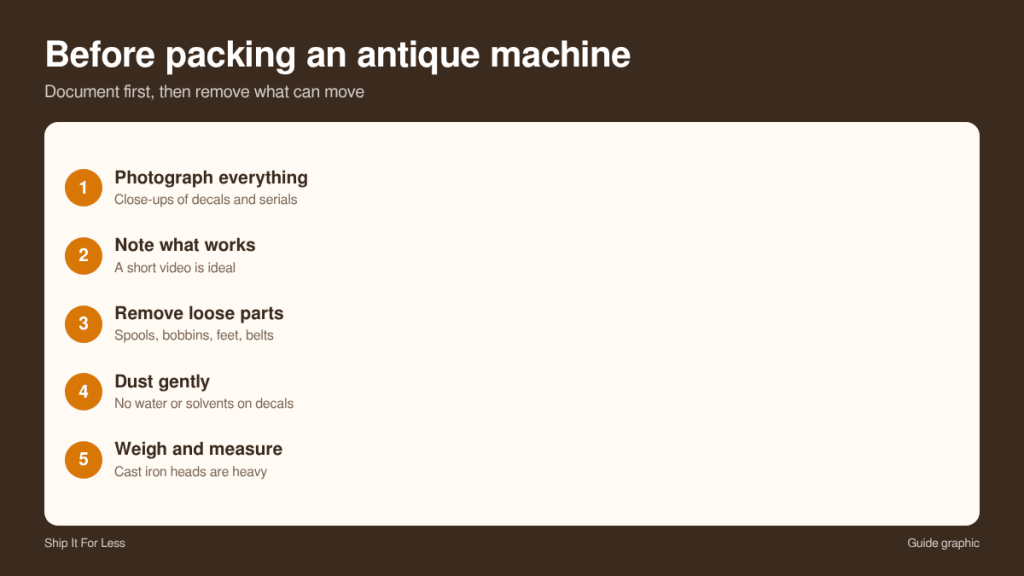
- Photograph everything. Take photos of each side, the decals, the bed, the serial number, the base or cabinet, and any existing chips, cracks or wear. Close-ups of decals are especially useful, since decal damage is common and hard to prove later.
- Note what works. Turn the handwheel or press a few keys and record whether the mechanism moves freely. A short video is ideal.
- Remove loose and removable parts. Take off thread spools, bobbins, presser feet, attachments, belts, the bobbin case and any loose accessories. For typewriters, remove the spool covers if they are loose and any paper.
- Dust gently. Use a soft brush or dry cloth. Do not use water or solvents on old decals or shellac finishes.
- Weigh and measure. Many cast iron sewing machine heads weigh a surprising amount on their own, and cabinets and treadle bases add more. Accurate numbers matter for the shipping method you choose.
Portable sewing machines in cases
Portable machines often come with a wooden or fabric-covered case with a base. The case looks protective, but the latches and hinges were not designed for shipping.
- Lower the presser foot onto a scrap of fabric to keep it from moving and to protect the feed dogs.
- Secure the needle bar in its lowest position, or remove the needle entirely.
- Tie or tape down the handwheel and any moving levers so they cannot spin or swing.
- Check that the machine head is firmly attached to its base. If it relies on hinge pins, make sure they are secure or remove the head.
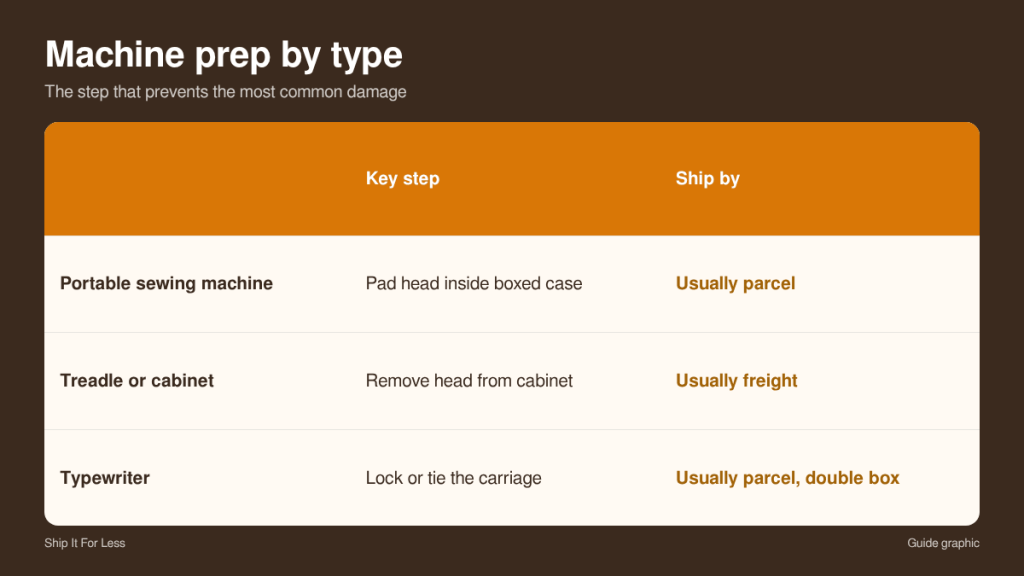
- Pack the head and base separately, or pad the inside of the case so the head cannot move, then box the closed case with at least 2 to 3 inches of cushioning on every side.
- Never rely on the case latches. Wrap the case with stretch wrap or straps to keep it closed.
Treadle and cabinet sewing machines
Treadle and cabinet machines combine a heavy cast iron head, a wooden cabinet and often a cast iron base. They are the most likely to be damaged if shipped assembled.
Remove the head
Most treadle and cabinet machines allow you to remove the head by taking out the hinge screws or pins. This is usually the single most important step. A head left in the cabinet can tear loose under vibration and crack the cabinet or base. Bag and label the hinge pins and screws, and tape the bag inside a drawer.
Prepare the cabinet
- Remove drawers, wrap them individually, and pack their contents separately.
- Secure the lid and leaf so they cannot swing open.
- Wrap the cabinet in moving blankets first, then stretch wrap over the blankets. Never put plastic directly on old wood finishes.
- Protect corners and drawer pulls with cardboard guards.
Protect the treadle base
Remove the treadle belt. Wrap the treadle and the cast iron legs in padding. Cast iron is strong under load but can crack from sharp impacts, so make sure nothing heavy can drop onto it.
Pack accessories, manuals and small parts
Original attachments, manuals, oil cans, bobbin tins and puzzle boxes can add real value to an antique sewing machine, and they are the items most likely to go missing. Wrap each small part in acid-free tissue or a small zip bag, label it, and place everything in one sturdy box marked “Machine accessories.” Paper manuals and instruction booklets should go flat in a plastic sleeve so they stay dry. If the machine came with original drawer contents, photograph them before removing them so the set can be put back the same way. Keep this box with the head or strapped to the same pallet, so the accessories travel with the machine instead of becoming a separate shipment that can be delayed.
Antique and vintage typewriters
Typewriters have delicate mechanisms that are easily bent by a sudden jolt.
- Lock the carriage. Many typewriters have a carriage lock. If yours does not, center the carriage and tie or tape it in place so it cannot slide.
- Protect the typebars. Make sure the typebars are resting in their basket and none are raised. Avoid pressing keys during packing.
- Remove the ribbon spools if loose. Wrap them separately.
- Secure the platen knobs and return lever. Wrap them in padding so they do not catch.
- Use a box that surrounds the machine with cushioning. Wrap the typewriter in foam or bubble wrap, place it in a box with at least 2 to 3 inches of cushioning on all sides, then double box it for extra protection.
If your typewriter has a case, the case can go inside the box, but do not ship a typewriter in its case alone.
Parcel or freight
Portable sewing machines and most typewriters can travel by parcel if packed well and kept within carrier limits. FedEx and UPS accept packages up to 150 pounds and 165 inches in length plus girth. USPS accepts up to 70 pounds and 130 inches in length plus girth.
Treadle and cabinet machines are better as LTL freight. Pack the head in its own padded box, wrap the cabinet and base, and secure all pieces together on a pallet or in a crate. Freight lets the heavy items travel strapped down rather than tossed in parcel sorting systems.
Example density check
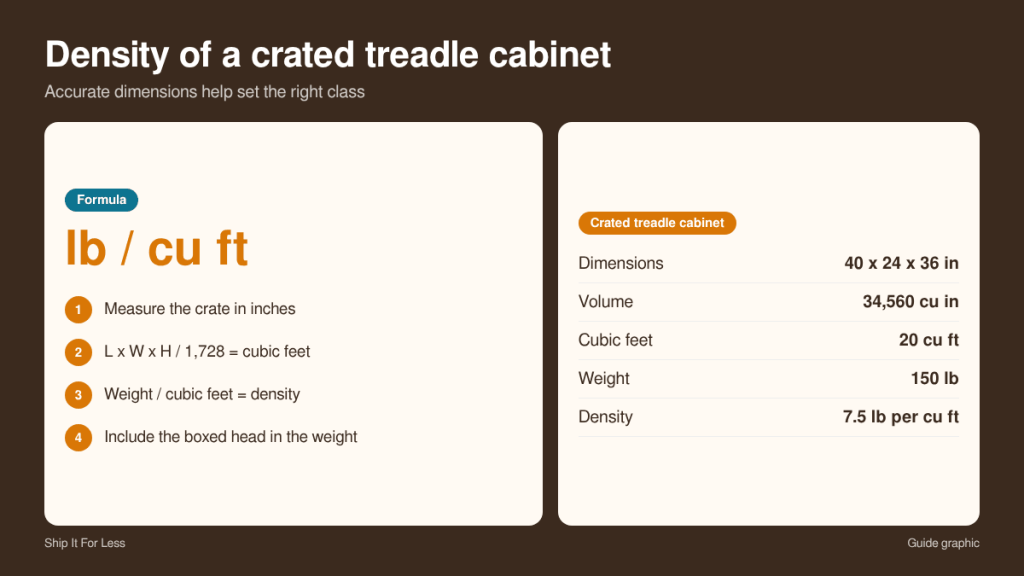
A crated treadle cabinet with its boxed head, measuring 40 x 24 x 36 inches, is 34,560 cubic inches, or 20 cubic feet. At 150 pounds packed, its density is 150 divided by 20, or 7.5 pounds per cubic foot. Accurate dimensions help you get the right class under the density-based NMFC system that has applied since July 19, 2025.
Insurance and value
Some antique machines are common and modestly valued, while rare models, early typewriters and machines with excellent original decals can be worth much more. If the value is significant:
- Get an appraisal or document recent comparable sales.
- Buy added insurance for the declared value, since carrier liability is often limited.
- Keep photos and condition notes until the machine arrives and has been inspected.
Unpacking and setup
- Inspect boxes and crates before signing for freight. Note any visible damage on the delivery receipt.
- Unpack slowly and check the head, decals, bed, cabinet and base against your photos.
- Reinstall the sewing machine head with its hinge pins, reconnect the belt and test the mechanism gently.
- For typewriters, release the carriage lock and test keys slowly.
- Report concealed damage to the carrier quickly with photos.
Frequently asked questions
Should I remove the sewing machine head from the cabinet?
Yes. The head is heavy and can tear loose in transit. Remove it, pad it and pack it separately.
Can I ship a typewriter in its original case?
Put the case inside a well-cushioned box. A case alone does not protect the machine from impacts.
How do I lock a typewriter carriage?
Use the carriage lock if your model has one. Otherwise, center the carriage and tie or tape it in place.
Is freight necessary for a treadle sewing machine?
It is usually the safest option, since the cabinet and cast iron base are bulky and heavy.
Shipping an heirloom machine?
Antique machines need careful packing to survive the trip. Antique shipping in Houston includes professional packing and crating for heavy, delicate pieces.